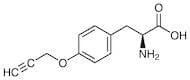
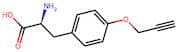
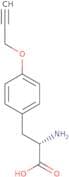
CAS 610794-20-2
:L-Tyrosine, O-2-propynyl-
Description:
L-Tyrosine, O-2-propynyl- is a derivative of the amino acid L-tyrosine, which is a non-essential amino acid important for protein synthesis and the production of neurotransmitters. This specific compound features a propynyl group attached to the oxygen of the hydroxyl group on the aromatic ring of tyrosine, which may influence its solubility and reactivity. Generally, derivatives of L-tyrosine can exhibit various biological activities, including potential roles in neurotransmitter synthesis, antioxidant properties, and effects on mood and cognitive function. The presence of the propynyl group may also impart unique chemical properties, such as altered reactivity or interaction with biological targets. As with many amino acid derivatives, the compound may be of interest in pharmaceutical research, particularly in the development of new therapeutic agents. However, specific characteristics such as melting point, solubility, and stability would require empirical data for precise evaluation. Always consult relevant safety data sheets and literature for handling and application information.
Formula:C12H13NO3
Synonyms:- O-2-Propyn-1-yl-L-tyrosine HCl
- (2S)-2-amino-3-(4-prop-2-ynoxyphenyl)propanoicacid
- L-Tyrosine, O-2-propyn-1-yl-
- O-2-propyn-1-yl-L-tyrosine
- H-L-Tyr(Propargyl)-OH
Sort by
Purity (%)
0
100
|
0
|
50
|
90
|
95
|
100
Found 4 products.
H-L-Tyr(Propargyl)-OH
CAS:Formula:C12H13NO3Purity:>98.0%(T)(HPLC)Color and Shape:White to Light yellow powder to crystalMolecular weight:219.24(S)-2-Amino-3-(4-(prop-2-yn-1-yloxy)phenyl)propanoic acid
CAS:(S)-2-Amino-3-(4-(prop-2-yn-1-yloxy)phenyl)propanoic acidPurity:95%(S)-2-Amino-3-(4-(prop-2-yn-1-yloxy)phenyl)propanoic acid
CAS:Formula:C12H13NO3Purity:95%Molecular weight:219.24O-2-Propyn-1-yl-L-tyrosine HCl
CAS:O-2-Propyn-1-yl-L-tyrosine (OPT) is a synthetase that catalyzes the formation of covalent linkages between L-tyrosine and propyne. It has been shown to be upregulated in response to light exposure and is involved in the synthesis of proteins with reactive cyclic peptides. OPT has also been used as a model for studying protein synthesis, which is important for structural biology and cell lysis. OPT has been shown to exhibit biomimetic properties, such as uptake by cells and cell lysis, which are similar to those of the natural substrate, L-tyrosine.Formula:C12H14ClNO3Purity:Min. 95%Molecular weight:255.7 g/mol