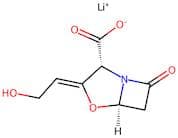
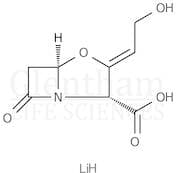
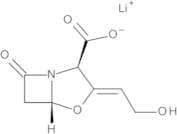
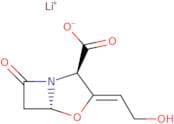
CAS 61177-44-4
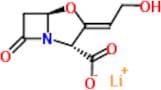
:4-Oxa-1-azabicyclo[3.2.0]heptane-2-carboxylic acid, 3-(2-hydroxyethylidene)-7-oxo-, lithium salt (1:1), (2R,3Z,5R)-
- 4-Oxa-1-azabicyclo[3.2.0]heptane-2-carboxylic acid, 3-(2-hydroxyethylidene)-7-oxo-, lithium salt (1:1), (2R,3Z,5R)-
- 4-Oxa-1-azabicyclo[3.2.0]heptane-2-carboxylic acid, 3-(2-hydroxyethylidene)-7-oxo-, monolithium salt, (2R,3Z,5R)-
- 4-Oxa-1-azabicyclo[3.2.0]heptane-2-carboxylic acid, 3-(2-hydroxyethylidene)-7-oxo-, monolithium salt, [2R-(2α,3Z,5α)]-
- Lithium (2R-(2alpha,3(Z),5alpha))-3-(2-hydroxyethylidene)-4-oxa-7-oxo-1-azabicyclo(3.2.0)heptane-2-carboxylate
- Lithium clavulanate
Clavulanate Lithium
CAS:Nucleic acids and their salts, whether or not chemically defined; other heterocyclic compounds, nesoiFormula:C8H8NO5·LiColor and Shape:White Light Yellow PowderMolecular weight:205.05625lithium [2R-(2α,3(Z),5α)]-3-(2-hydroxyethylidene)-4-oxa-7-oxo-1-azabicyclo[3.2.0]heptane-2-carboxylate
CAS:Formula:C8H8LiNO5Purity:97%Color and Shape:SolidMolecular weight:205.0938Clavulanate lithium
CAS:Clavulanate lithium (Clavulanic acid lithium) is an inhibitor of β-lactamase.Formula:C8H8LiNO5Purity:99.79%Color and Shape:SolidMolecular weight:205.09Clavulanate Lithium
CAS:Formula:C8H8NO5·LiColor and Shape:White To Off-White SolidMolecular weight:198.16 6.94Clavulanate Lithium
CAS:Controlled ProductStability Hygroscopic
Applications Clavulanate Lithium is used as an antibacterial compound against a β-lactamase producing strain of Staphylococcus aureus.
References Cuffini, A. et al.: Microbios., 87, 31 (1996); Rodriguez, M. et al.: Int. J. Antimicrob. Agents., 29 332 (2007);Formula:C8H8NO5·LiColor and Shape:Off-WhiteMolecular weight:205.09Clavulanate Lithium
CAS:Clavulanate lithium is an antibiotic that inhibits the growth of bacteria by binding to penicillin-binding proteins. It is a prodrug that is hydrolyzed in vivo to clavulanic acid, its active form. The inhibitory properties of clavulanate lithium are similar to those of amoxicillin, but it has greater activity against pseudomonas aeruginosa and Staphylococcus aureus. Clavulanate lithium has been shown to increase the plasma concentrations of amoxicillin when used in combination with this drug. It is also effective against a variety of bacterial infections, including Escherichia coli, Proteus mirabilis, Enterobacter cloacae, and Staphylococcus aureus isolates. Clavulanate lithium can be used as an adjunct therapy for the treatment of respiratory tract infections caused by common viruses such as influenza and rhinovirus. Clavulanate
Formula:C8H9NO5•LiPurity:Min. 95%Color and Shape:PowderMolecular weight:206.1 g/mol



![lithium [2R-(2α,3(Z),5α)]-3-(2-hydroxyethylidene)-4-oxa-7-oxo-1-azabicyclo[3.2.0]heptane-2-carboxy…](/_next/image/?url=https%3A%2Fstatic.cymitquimica.com%2Fproducts%2FIN%2Fthumb%2FDA00EF4Z.jpg&w=3840&q=75)