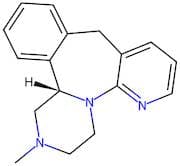
CAS 61337-87-9
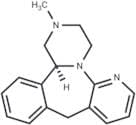
:Esmirtazapine
- ( )-Mirtazapine
- (14bS)-1,2,3,4,10,14b-Hexahydro-2-methylpyrazino[2,1-a]pyrido[2,3-c][2]benzazepine
- (14bS)-2-methyl-1,2,3,4,10,14b-hexahydropyrazino[2,1-a]pyrido[2,3-c][2]benzazepine
- (S)-6-Azamianserin
- (S)-Mirtazapine
- (S)-Org 3770
- Esmirtazapine
- Org 44-20
- Pyrazino[2,1-a]pyrido[2,3-c][2]benzazepine, 1,2,3,4,10,14b-hexahydro-2-methyl-, (14bS)-
- Pyrazino[2,1-a]pyrido[2,3-c][2]benzazepine, 1,2,3,4,10,14b-hexahydro-2-methyl-, (S)-
- Unii-4685R51V7M
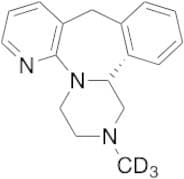
S-Mirtazapine-d3
CAS:Controlled ProductApplications Isotope labelled S-Mirtazapine is an enantiomer of Mirtazapine (M365000); an antidepressant. R-Mirtazapine showed antinociceptive effects in acute thermal nociception, whereas S-Mirtazapine showed pronociceptive effects.
References Muth-Selbach, Uta., et al.: Brain Res. Bull., 79(1), 63-68 (2009); Smith, Donald F., et al.: Psychopharmacology, 200(2), 273-279 (2008); Freynhagen, Rainer., et al.: Brain Res. Bull., 69(2), 168-173 (2006)Formula:C17D3H16N3Color and Shape:NeatMolecular weight:268.371(S)-Mirtazapine
CAS:(S)-Mirtazapine ((S)-Org3770) is a 5-HT2 receptor antagonist with pro-nociceptive effects that can be used to study depression.Formula:C17H19N3Purity:99.37%Color and Shape:SolidMolecular weight:265.35S-Mirtazapine
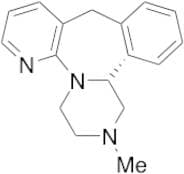
CAS:Controlled ProductApplications S-Mirtazapine is an enantiomer of Mirtazapine (M365000); an antidepressant. R-Mirtazapine showed antinociceptive effects in acute thermal nociception, whereas S-Mirtazapine showed pronociceptive effects.
References Muth-Selbach, Uta., et al.: Brain Res. Bull., 79(1), 63-68 (2009); Smith, Donald F., et al.: Psychopharmacology, 200(2), 273-279 (2008); Freynhagen, Rainer., et al.: Brain Res. Bull., 69(2), 168-173 (2006)Formula:C17H19N3Color and Shape:NeatMolecular weight:265.35S-Mirtazapine
CAS:S-Mirtazapine is a tetracyclic antidepressant that is used for the treatment of major depressive disorder. It has been found to bind to many receptors, including serotonin (5-HT) and noradrenaline (NA) receptors. S-Mirtazapine also inhibits ion channels and ligand-gated ion channels, which are involved in neurotransmission. In addition, it has been found to inhibit the production of proinflammatory cytokines and chemokines by lipopolysaccharide (LPS). S-Mirtazapine is a high purity product with a CAS number of 61337-87-9.Formula:C17H19N3Purity:Min. 95%Molecular weight:265.35 g/mol