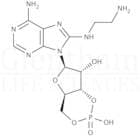
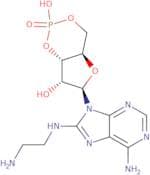
![Adenosine,8-[(2-aminoethyl)amino]-, cyclic 3',5'-(hydrogen phosphate)](/_next/image/?url=https%3A%2Fstatic.cymitquimica.com%2Fcas-image%2Fthumb-webp%2F294657-adenosine-8-2-aminoethyl-amino-cyclic-3-5-hydrogen-phosphate.webp&w=3840&q=75)
CAS 61363-29-9
:Adenosine,8-[(2-aminoethyl)amino]-, cyclic 3',5'-(hydrogen phosphate)
Description:
Adenosine, 8-[(2-aminoethyl)amino]-, cyclic 3',5'-(hydrogen phosphate), commonly referred to as a cyclic nucleotide, is a derivative of adenosine that plays a crucial role in cellular signaling. This compound features a cyclic phosphate group, which is integral to its function as a second messenger in various biochemical pathways. The presence of the 2-aminoethylamino group enhances its solubility and reactivity, allowing it to interact effectively with target proteins and enzymes. As a cyclic nucleotide, it is involved in the regulation of numerous physiological processes, including metabolism, cell growth, and differentiation. The cyclic structure contributes to its stability and ability to transmit signals within cells. Additionally, this compound may exhibit various biological activities, including modulation of enzyme activity and influence on ion channel function. Its CAS number, 61363-29-9, is a unique identifier that facilitates the cataloging and study of this specific chemical entity in scientific literature and databases.
Formula:C12H18N7O6P
Synonyms:- 4H-Furo[3,2-d]-1,3,2-dioxaphosphorin,adenosine deriv.
- 8-(b-Aminoethylamino)adenosine 3',5'-cyclic phosphate
Sort by
Purity (%)
0
100
|
0
|
50
|
90
|
95
|
100
Found 2 products.
8-(2-Aminoethyl)aminoadenosine 3',5'-cyclic monophosphate
CAS:8-(2-Aminoethyl)aminoadenosine 3',5'-cyclic monophosphate (8-AEACMP) is a structural analog of the purine nucleotide adenosine. It has been shown to be an effective inhibitor of HIV replication in vitro and in vivo. 8-AEACMP blocks HIV transcription by binding to the cellular target, the enzyme ribonucleotide reductase. This binding prevents the formation of an enzyme-substrate complex that is required for DNA synthesis. 8-AEACMP binds to two sites on this enzyme: one site is at a catalytic site that is not involved in substrate binding, and the other site is at a regulatory site. The inhibitory effect of 8-AEACMP on HIV transcription results from its ability to bind at both sites simultaneously.Formula:C12H18N7O6PPurity:Min. 95%Molecular weight:387.29 g/mol