CAS 61380-27-6
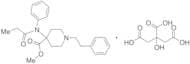
:Carfentanil citrate
Description:
Carfentanil citrate is a potent synthetic opioid primarily used as a tranquilizer for large animals, such as elephants, due to its extreme potency—approximately 100 times stronger than fentanyl and about 10,000 times stronger than morphine. It is classified as a Schedule II controlled substance due to its high potential for abuse and risk of overdose. The compound acts primarily on the mu-opioid receptors in the brain, leading to profound analgesic and sedative effects. Carfentanil citrate is typically administered in veterinary settings and is not intended for human use. Its chemical structure includes a complex arrangement of carbon, hydrogen, nitrogen, and oxygen atoms, contributing to its pharmacological properties. Due to its potency, even minute quantities can lead to severe respiratory depression and death in humans, making it a significant concern in cases of accidental exposure or misuse. Safety measures and regulations are critical when handling this substance to prevent accidental overdose and ensure proper usage in veterinary medicine.
Formula:C24H30N2O3·C6H8O7
InChI:InChI=1S/C24H30N2O3.C6H8O7/c1-3-22(27)26(21-12-8-5-9-13-21)24(23(28)29-2)15-18-25(19-16-24)17-14-20-10-6-4-7-11-20;7-3(8)1-6(13,5(11)12)2-4(9)10/h4-13H,3,14-19H2,1-2H3;13H,1-2H2,(H,7,8)(H,9,10)(H,11,12)
InChI key:InChIKey=ZSLYVCXNFQPCGT-UHFFFAOYSA-N
SMILES:N(C(CC)=O)(C1(C(OC)=O)CCN(CCC2=CC=CC=C2)CC1)C3=CC=CC=C3.C(CC(O)=O)(CC(O)=O)(C(O)=O)O
Synonyms:- R 33799
- Carfentanil citrate
- Carfentanyl citrate
- 4-Piperidinecarboxylic acid, 4-[(1-oxopropyl)phenylamino]-1-(2-phenylethyl)-, methyl ester, 2-hydroxy-1,2,3-propanetricarboxylate (1:1)
Sort by
Purity (%)
0
100
|
0
|
50
|
90
|
95
|
100
Found 4 products.
Carfentanil Citrate
CAS:Controlled ProductApplications Carfentanil Citrate is a Fentanyl (F275000) analogue, an opioid receptor agonist. Analgesic agent.
Not a dangerous good if item is equal to or less than 1g/ml and there is less than 100g/ml in the package
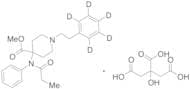
References Zernig, G., et al.: Life Sci., 57, 2113 (1995), Bot, G., et al.: J. Pharmacol. Exper. Therap., 285, 1207 (1998), Gear, et al.: Neuroscience, 66, 5 (1995), Boronat, et al.: Br. J. Pharmacol., 125, 175 ( 1998), Ozdogan., et al.: Eur. J. Pharmacol., 460, 127 (2003),Formula:C30H38N2O10Color and Shape:NeatMolecular weight:586.63Carfentanil Citrate-d5
CAS:Controlled ProductFormula:C24D5H25N2O3·C6H8O7Color and Shape:NeatMolecular weight:591.661Carfentanil Citrate (1 mg/ml in Acetonitrile)
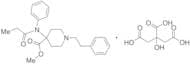
CAS:Controlled ProductFormula:C30H38N2O10Color and Shape:Single SolutionMolecular weight:586.634-(Methoxycarbonyl)-1-Phenethyl-4-(N-Phenylpropionylamino)Piperidinium Dihydrogen Citrate
CAS:Controlled Product4-(Methoxycarbonyl)-1-Phenethyl-4-(N-Phenylpropionylamino)Piperidinium Dihydrogen Citrate is a chemical compound that is used as an absorption enhancer for drugs and other chemicals. It has been shown to bind to the adenosine A3 receptor, which may be a possible mechanism of action. This drug has been shown to have clinical relevance in humans because it can be detected in blood samples and urine samples. 4-(Methoxycarbonyl)-1-Phenethyl-4-(N-Phenylpropionylamino)Piperidinium Dihydrogen Citrate has also been shown to stimulate the release of fatty acids and monoamine neurotransmitters from nerve endings, which may contribute to its effects on pain relief. The analytical method for this drug is based on receptor binding assays with fentanyl as a standard reference.Formula:C31H39NO10Purity:Min. 95%Molecular weight:585.64 g/mol