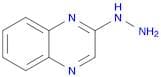
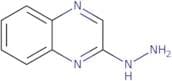
CAS 61645-34-9
:2-hydrazinylquinoxaline
Description:
2-Hydrazinylquinoxaline is an organic compound characterized by the presence of a hydrazine functional group (-NH-NH2) attached to a quinoxaline ring system. Quinoxaline itself is a bicyclic compound composed of two fused aromatic rings, specifically a benzene and a pyrazine ring. This compound typically exhibits properties such as being a solid at room temperature, with potential applications in medicinal chemistry due to its structural similarity to various bioactive molecules. It may display biological activities, including antimicrobial or antitumor properties, which are of interest in pharmaceutical research. The presence of the hydrazine group can also facilitate further chemical modifications, making it a versatile intermediate in organic synthesis. Additionally, 2-hydrazinylquinoxaline may participate in various chemical reactions, such as hydrazone formation or oxidation, which can be leveraged in synthetic pathways. As with many nitrogen-containing heterocycles, it is important to handle this compound with care, considering potential toxicity and reactivity.
Formula:C8H8N4
InChI:InChI=1/C8H8N4/c9-12-8-5-10-6-3-1-2-4-7(6)11-8/h1-5H,9H2,(H,11,12)
SMILES:c1ccc2c(c1)ncc(=NN)[nH]2
Synonyms:- 2-Hydrazinoquinoxaline
- Quinoxaline, 2-Hydrazinyl-
Sort by
Purity (%)
0
100
|
0
|
50
|
90
|
95
|
100
Found 3 products.
2-Hydrazinoquinoxaline
CAS:2-Hydrazinoquinoxaline is a potent cytotoxic agent that inhibits methionine aminopeptidase, an enzyme that regulates the synthesis of proteins. 2-Hydrazinoquinoxaline has been shown to be active against cancer cells in culture and to produce cytostatic effects in vivo. The IC50 value for 2-hydrazinoquinoxaline was found to be less than 1 μM with an ED50 of approximately 10 μM, which indicates that this drug is more potent than some other quinoxalines. 2-Hydrazinoquinoxaline is not active against bacteria, but it has been shown to inhibit the growth of P. aeruginosa in vitro.
Formula:C8H8N4Purity:Min. 95%Molecular weight:160.18 g/molRef: 3D-LCA64534
Discontinued product