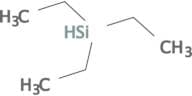
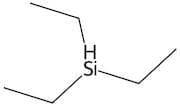
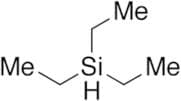
CAS 617-86-7
:Triethylsilane
- Ls 1320
- Nsc 93579
- Sit 8330.0
- Triethyl silane
- Triethylhydrosilane
- Triethylsilan
- Triethylsilane
- Triethylsilicon hydride
- Trietilsilano
- Silane, triethyl-
- triethylsilicon
- Triethylsilyl hydride
- See more synonyms
Triethylsilane
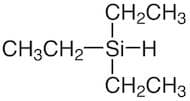
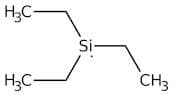
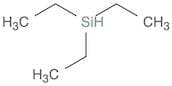
CAS:Formula:C6H16SiPurity:>98.0%(GC)Color and Shape:Colorless to Almost colorless clear liquidMolecular weight:116.28Triethylsilane, 98+%
CAS:Triethylsilane is used for the hydrosilation of olefins to prepare alkyl silanes. It acts as a reducing agent in the reduction of 2-chromanols, since it has an active hydride. It acts as a catalyst for redox initiated cationic polymerization, regioselective reductive coupling of enones and allenes,Formula:C6H15SiPurity:98+%Color and Shape:Clear colorless, LiquidMolecular weight:115.27Triethylsilane, 99%
CAS:Triethylsilane, 99%
Formula:(C2H5)3SiHPurity:99%Color and Shape:colorless liq.Molecular weight:116.28Ref: IN-DA0035QU
25kgTo inquire25g21.00€50g24.00€100g27.00€250g43.00€500g67.00€1kg91.00€5kg224.00€10kg580.00€Triethylsilane
CAS:Formula:C6H16SiPurity:≥ 99.0%Color and Shape:Clear, colourless liquidMolecular weight:116.28Triethylsilane
CAS:S17595 - Triethylsilane
Formula:C6H16SiPurity:99%Color and Shape:Liquid, Clear LiquidMolecular weight:116.279Triethylsilane
CAS:TriethylsilaneFormula:C6H16SiPurity:98%Color and Shape: clear. colourless liquidMolecular weight:116.28g/molTriethylsilane
CAS:Triethylsilane is a colorless liquid with a boiling point of -128.3°C and a density of 0.81 g/mL at 20°C. It is soluble in water, ethanol, ether, and acetone but insoluble in benzene or chloroform. Triethylsilane is used as a reagent to prepare biological samples for analysis by gas chromatography-mass spectrometry (GC-MS) or electron microscopy (EM). The reaction mechanism of triethylsilane involves the hydroxyl group that reacts with hydrogen fluoride to form hydrofluoric acid and alcohols. Triethylsilane has been shown to have properties that are similar to those of serotonin, such as its ability to bind to 5-ht2 receptors on the cell membrane and activate the enzyme adenylate cyclase, which increases intracellular levels of cyclic AMP. This chemical also possesses hydrogen bonding interactions with other molecules due to its high polarity.Formula:C6H16SiPurity:Min. 98 Area-%Color and Shape:Colorless Clear LiquidMolecular weight:116.28 g/molTriethylsilane
CAS:Applications Triethylsilane is a trialkylsilicon hydride used in the synthesis of alkylsilanes via hydrosilation of olefins. Triethylsilane is also used as an effective reducing agent.
Not a dangerous good if item is equal to or less than 1g/ml and there is less than 100g/ml in the package
References Cesca, S. et al.: Chim. Indust., 51, 1093 (1969): Svoboda, P. et al.: Coll. Czech. Chem. Comm., 37, 1585 (1972); Tsuji, J. et al.: Tetrahedron, 30, 2143 (1974):Formula:C6H16SiColor and Shape:NeatMolecular weight:116.28TRIETHYLSILANE, 98%
CAS:Tri-substituted Silane Reducing Agent
Organosilanes are hydrocarbon-like and possess the ability to serve as both ionic and free-radical reducing agents. These reagents and their reaction by-products are safer and more easily handled and disposed than many other reducing agents. The metallic nature of silicon and its low electronegativity relative to hydrogen lead to polarization of the Si-H bond yielding a hydridic hydrogen and a milder reducing agent compared to aluminum-, boron-, and other metal-based hydrides. A summary of some key silane reductions are presented in Table 1 of the Silicon-Based Reducing Agents brochure.
Triethylsilane; Triethylsilyl hydride; Triethylsilicon hydride
Viscosity: 4.9 cStDipole moment: 0.75 debyeSurface tension: 20.7 mN/mΔHform: -172 kJ/molΔHcomb: -5,324 kJ/molVapor pressure, 20 °: 40 mmSilylates tertiary alcohols in presence of tris(pentafluorophenyl)boraneSilylates arenes in presence of Ru catalyst and t-butylethyleneUsed in reductive cyclization of ynalsReadily converted directly to triethylsilyl carboxylatesUsed to reduce metal saltsEnhances deprotection of t-butoxycarbonyl-protected amines and tert-butyl estersUsed in the reductive amidation of oxazolidinones with amino acids to provide dipeptidesConverts aldehydes to symmetrical and unsymmetrical ethersUsed in the ‘in-situ’ preparation of diborane and haloboranesExtensive review of silicon based reducing agents: Larson, G.; Fry, J. L. "Ionic and Organometallic-Catalyzed Organosilane Reductions", Wipf, P., Ed.; Wiley, 2007Formula:C6H16SiPurity:98%Color and Shape:Colourless LiquidMolecular weight:116.28Ref: 3H-SIT8330.0
Discontinued product