CAS 619-03-4
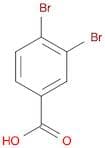
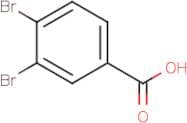
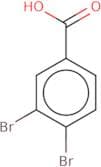
:3,4-dibromobenzoic acid
Description:
3,4-Dibromobenzoic acid is an aromatic carboxylic acid characterized by the presence of two bromine substituents on the benzene ring, specifically at the 3 and 4 positions relative to the carboxylic acid group. This compound has a molecular formula of C7H4Br2O2 and features a benzoic acid structure, which contributes to its acidic properties. It is typically a white to off-white crystalline solid that is sparingly soluble in water but more soluble in organic solvents such as ethanol and acetone. The presence of bromine atoms enhances its reactivity, making it useful in various chemical syntheses, including the preparation of pharmaceuticals and agrochemicals. Additionally, 3,4-dibromobenzoic acid can serve as a building block in organic synthesis due to its functional groups, allowing for further derivatization. Its physical and chemical properties, such as melting point and boiling point, can vary based on purity and environmental conditions. Safety precautions should be observed when handling this compound, as it may pose health risks if ingested or inhaled.
Formula:C7H4Br2O2
InChI:InChI=1/C7H4Br2O2/c8-5-2-1-4(7(10)11)3-6(5)9/h1-3H,(H,10,11)
Synonyms:- Benzoic Acid, 3,4-Dibromo-
Sort by
Purity (%)
0
100
|
0
|
50
|
90
|
95
|
100
Found 4 products.
3,4-Dibromobenzoic acid
CAS:Formula:C7H4Br2O2Purity:97%Color and Shape:SolidMolecular weight:279.91353,4-Dibromobenzoic acid
CAS:3,4-Dibromobenzoic acid (DBBA) is a white solid that has a melting point of -5°C. It is produced by the electrolysis of bromoacetic acid in the presence of aluminium chloride and phenylacetonitrile, followed by hydrolysis. DBBA can be used for the synthesis of 2-amino-4-bromobenzamide, which is an important intermediate for dyes and pharmaceuticals. The compound has been studied as a precursor to trifluoromethyl compounds with high thermal stability. DBBA can be prepared by bromination of benzene with bromine in acetic acid, followed by fluorination with hydrogen fluoride in acetic acid to yield 3-fluoro-4-(trifluoromethyl)benzoic acid and 3,4-dibromobenzoic acid. This process also yields anhydrous hydrogen fluoride as a co
Formula:C7H4Br2O2Purity:Min. 95%Color and Shape:PowderMolecular weight:279.91 g/mol