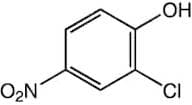
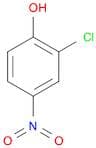
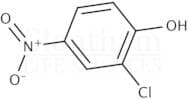
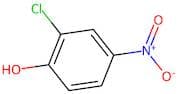
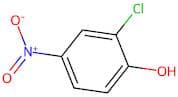
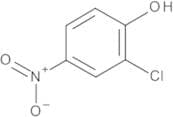
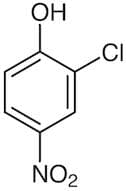
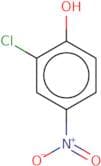
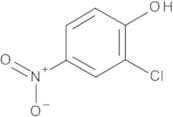
CAS 619-08-9
:Nitrofungin
- 2-Chloro-4-Nitrophenolate
- Brn 2046372
- Nitrofungin
- Nsc 1316
- Phenol, 2-chloro-4-nitro-
- 2-Chloro-4-nitrophenol
- 4-06-00-01353 (Beilstein Handbook Reference)
- 2-Chloro-4-nitro
- 4-NITRO-2-CHLOROPHENOL
- 2-Chloro-p-nitrophenol
- P-NITRO-O-CHLOROPHENOL
- Nitrofurgin
- CHLORO(2-)-4-NITROPHENOL
- 1-CHLORO-2-HYDROXY-5-NITROBENZENE
- 2-chloro-4-nitro-pheno
- 2-CHLORO-4-NITROPHENOL, 1GM, NEAT
- See more synonyms
2-Chloro-4-nitrophenol, 97%
CAS:2-Chloro-4-nitrophenol, is frequently used as building blocks for dyes, plastics, explosives. It acts as a catalytic agent, petrochemical additive and used in organic synthesis. It can react with sulfuric acid dimethyl ester to produce 2-chloro-4-nitro-anisole. This reaction will need reagents K2CO3Formula:C6H4ClNO3Purity:97%Color and Shape:White to pale cream to pale yellow to pale brown to gray, PowderMolecular weight:173.55Ref: 54-BUP17706
5mgTo inquire10mgTo inquire25mgTo inquire50mgTo inquire100mgTo inquire500mgTo inquire2-Chloro-4-nitrophenol
CAS:2-Chloro-4-nitrophenolFormula:C6H4ClNO3Purity:98%Color and Shape: yellow solidMolecular weight:173.55g/mol2-Chloro-4-nitrophenol
CAS:Controlled ProductFormula:C6H4ClNO3Color and Shape:NeatMolecular weight:173.552-Chloro-4-nitrophenol
CAS:Formula:C6H4ClNO3Purity:>98.0%(GC)(T)Color and Shape:White to Light yellow to Dark green powder to crystalMolecular weight:173.552-Chloro-4-nitrophenol
CAS:2-Chloro-4-nitrophenol: phenolic COX inhibitor, reduces prostaglandins, lessens inflammation and pain.Formula:C6H4ClNO3Purity:97.88%Color and Shape:White Or Kind Of Whith Powder Or Needle Form CrystallizationMolecular weight:173.552-Chloro-4-nitrophenol
CAS:2-Chloro-4-nitrophenol (2CP) is a chemical that has been found to be an optical sensor for nitrite ion. It reacts with nitrite ion at a pH of 5 and changes its color from yellow or orange to red. 2CP is also an antimicrobial agent and has shown biological properties against bacteria, including the ability to inhibit bacterial growth and reduce the number of bacteria in human serum. The optimum concentration for the inhibition of bacterial growth was found to be 0.5 mg/mL, which is much lower than the concentration used in other studies. The genus, bacterial strain, and pH were all found to influence the activity of 2CP against bacteria. Process optimization trials have shown that 4-hydroxycinnamic acid can be used as an alternative substrate for 2CP's reaction with nitrite ion. Monoclonal antibodies were also developed that are specific for transfer reactions with nitrate ion and can be used as a detection system for nit
Formula:C6H4ClNO3Purity:Min. 95%Color and Shape:PowderMolecular weight:173.55 g/mol2-Chloro-4-nitrophenol
CAS:Controlled ProductApplications 2-Chloro-4-nitrophenol is used as a sole source of carbon and nitrogen by Cupriavidus strain a3.
References Tiwari, J., et al.: Bioresour. Technol., 223, 184-191 (2017)Formula:C6H4ClNO3Color and Shape:NeatMolecular weight:173.55