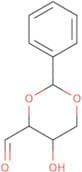
CAS 6195-62-6
:1,3-Dioxane-4-carboxaldehyde, 5-hydroxy-2-phenyl-
Description:
1,3-Dioxane-4-carboxaldehyde, 5-hydroxy-2-phenyl- (CAS 6195-62-6) is an organic compound characterized by its dioxane ring structure, which features a five-membered cyclic ether containing two oxygen atoms. This compound includes an aldehyde functional group, which is indicative of its reactivity and potential applications in organic synthesis. The presence of a hydroxyl group contributes to its polarity, enhancing its solubility in polar solvents. Additionally, the phenyl group attached to the dioxane structure provides aromatic characteristics, which can influence the compound's stability and reactivity. This compound may exhibit biological activity, making it of interest in medicinal chemistry and pharmaceutical research. Its unique structural features allow for various chemical transformations, making it a valuable intermediate in the synthesis of more complex molecules. Overall, 1,3-Dioxane-4-carboxaldehyde, 5-hydroxy-2-phenyl- is a versatile compound with potential applications in various fields, including organic synthesis and medicinal chemistry.
Formula:C11H12O4
Sort by
Purity (%)
0
100
|
0
|
50
|
90
|
95
|
100
Found 1 products.
2,4-O-Benzylidene-D-Threose
CAS:2,4-O-Benzylidene-D-Threose is a chemical compound that is used as a reagent in the synthesis of glycosphingolipids. It is prepared by the Wittig reaction of 2,4-dibromobenzaldehyde with potassium azide and phytosphingosine. The compound has also been used as a tool in biological studies to study the biosynthesis of glycosphingolipids. This product can react with carbinols to produce acetylides or diphosphate esters. 2,4-O-Benzylidene-D-Threose can be used as a reagent for the synthesis of methylmagnesium chloride, which is a Grignard reagent.Purity:Min. 95%