CAS 62068-78-4
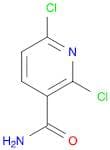
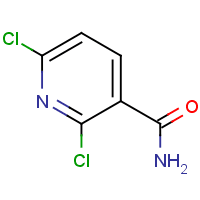
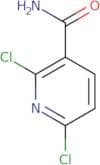
:2,6-Dichloropyridine-3-carboxamide
Description:
2,6-Dichloropyridine-3-carboxamide is an organic compound characterized by its pyridine ring, which is substituted at the 2 and 6 positions with chlorine atoms and at the 3 position with a carboxamide group. This compound typically appears as a solid and is soluble in polar organic solvents. Its molecular structure contributes to its potential applications in various fields, including pharmaceuticals and agrochemicals, due to its biological activity. The presence of the dichloro substituents can enhance its reactivity and influence its interaction with biological targets. Additionally, the carboxamide functional group can participate in hydrogen bonding, affecting its solubility and stability. As a chemical entity, 2,6-Dichloropyridine-3-carboxamide may exhibit properties such as moderate to high melting points and specific reactivity patterns typical of halogenated pyridines. Safety data should be consulted for handling and usage, as halogenated compounds can pose environmental and health risks.
Formula:C6H4Cl2N2O
Synonyms:- 2,6-Dichloronicotinamide
Sort by
Purity (%)
0
100
|
0
|
50
|
90
|
95
|
100
Found 4 products.
2,6-Dichloronicotinamide
CAS:Formula:C6H4Cl2N2OPurity:97%Color and Shape:SolidMolecular weight:191.01482,6-Dichloronicotinamide
CAS:Formula:C6H4Cl2N2OPurity:98%Color and Shape:SolidMolecular weight:191.012,6-Dichloropyridine-3-carboxamide
CAS:2,6-Dichloropyridine-3-carboxamide is a boronic acid that is used in organic synthesis. It is a cross-coupling partner in Suzuki and Sonogashira reactions. 2,6-Dichloropyridine-3-carboxamide can be prepared by the reaction of an aryl boronic acid with 2,6-dichloropyridine. This reaction proceeds smoothly at room temperature and has been shown to proceed with high yield. The compound was also found to inhibit tyrosine kinase activity when expressed in cells. It is an organometallic molecule that contains a pyridinium group and an alkene section. The metathesis reactions of this compound have been studied extensively and it has been shown to undergo both metathesis reactions under different conditions.Formula:C6H4Cl2N2OPurity:Min. 95%Molecular weight:191.01 g/mol