CAS 621-03-4
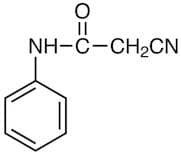
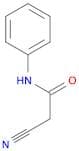
:2-Cyano-N-phenylacetamide
Description:
2-Cyano-N-phenylacetamide, with the CAS number 621-03-4, is an organic compound characterized by its functional groups, including a cyano group (-CN) and an amide group (-CONH-). This compound typically appears as a solid and is known for its role in various chemical reactions, particularly in organic synthesis. It exhibits moderate solubility in polar solvents due to the presence of the amide group, which can engage in hydrogen bonding. The cyano group contributes to its reactivity, making it a useful intermediate in the synthesis of pharmaceuticals and agrochemicals. Additionally, 2-cyano-N-phenylacetamide may exhibit biological activity, which has been explored in medicinal chemistry. Safety data indicates that, like many organic compounds, it should be handled with care, as it may pose health risks if ingested or inhaled. Proper laboratory practices, including the use of personal protective equipment, are recommended when working with this substance. Overall, its unique structure and reactivity make it a valuable compound in chemical research and applications.
Formula:C9H8N2O
InChI:InChI=1S/C9H8N2O/c10-7-6-9(12)11-8-4-2-1-3-5-8/h1-5H,6H2,(H,11,12)
InChI key:InChIKey=XCTQPMCULSZKLT-UHFFFAOYSA-N
SMILES:N(C(CC#N)=O)C1=CC=CC=C1
Synonyms:- (Phenylcarbamoyl)acetonitrile
- 2-Cyano-N-phenylacetamide
- Acetamide, 2-cyano-N-phenyl-
- Acetanilide, 2-cyano-
- Cyanoacetic acid anilide
- N-Phenyl-2-cyanoacetamide
- N-Phenylcyanoacetamide
- Nsc 6313
- Up 590-1
- alpha-Cyanoacetanilide
- α-Cyanoacetanilide
Sort by
Purity (%)
0
100
|
0
|
50
|
90
|
95
|
100
Found 5 products.
2-Cyanoacetanilide
CAS:Formula:C9H8N2OPurity:>98.0%(GC)Color and Shape:White to Light yellow powder to crystalMolecular weight:160.182-Cyanoacetanilide
CAS:2-Cyanoacetanilide belongs to the group of basic dyes. It is a reactive chemical that is used as an antimicrobial agent in textiles and leather. It has been shown to exhibit anticancer activity in laboratory tests. 2-Cyanoacetanilide undergoes nucleophilic substitutions with active methylenes, leading to the formation of reaction products such as chlorocarbonyls, alkylthios and nitro compounds. The presence of chlorine atoms on the molecule makes it a good candidate for use in monolayers because they can be easily removed by electrochemical impedance spectroscopy (EIS).Formula:C9H8N2OPurity:Min. 95%Molecular weight:160.18 g/mol