CAS 62133-77-1
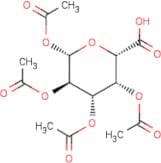
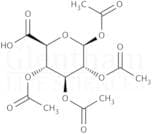
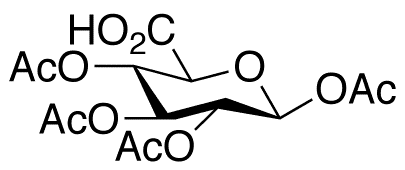
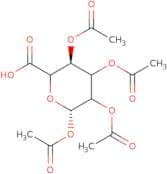
:(3S,6S)-3,4,5,6-tetraacetoxytetrahydropyran-2-carboxylic acid
Description:
(3S,6S)-3,4,5,6-tetraacetoxytetrahydropyran-2-carboxylic acid is a chemical compound characterized by its tetrahydropyran ring structure, which is a six-membered cyclic ether featuring oxygen. The presence of multiple acetoxy groups (acetate esters) at positions 3, 4, 5, and 6 contributes to its reactivity and solubility in organic solvents. The carboxylic acid functional group at position 2 imparts acidic properties, allowing it to participate in various chemical reactions, such as esterification and amidation. This compound is typically used in organic synthesis and may serve as an intermediate in the production of more complex molecules. Its stereochemistry, indicated by the (3S,6S) configuration, suggests specific spatial arrangements of atoms that can influence its biological activity and interactions. Overall, the compound's unique structure and functional groups make it a valuable substance in chemical research and applications.
Formula:C14H18O11
InChI:InChI=1/C14H18O11/c1-5(15)21-9-10(22-6(2)16)12(23-7(3)17)14(24-8(4)18)25-11(9)13(19)20/h9-12,14H,1-4H3,(H,19,20)/t9-,10?,11?,12?,14+/m0/s1
Sort by
Purity (%)
0
100
|
0
|
50
|
90
|
95
|
100
Found 6 products.
1,2,3,4-Tetra-O-acetyl-β-D-glucuronic Acid
CAS:Formula:C14H18O11Purity:98%Color and Shape:SolidMolecular weight:362.28611,2,3,4-Tetra-O-acetyl-β-D-glucopyranuronic acid
CAS:1,2,3,4-Tetra-O-acetyl-β-D-glucopyranuronic acidPurity:98%Molecular weight:362.29g/mol1,2,3,4-Tetra-O-acetyl-β-D-glucuronic acid
CAS:Formula:C14H18O11Purity:≥ 98.0%Color and Shape:White to off-white crystalline powderMolecular weight:362.291,2,3,4-Tetra-O-acetyl-β-D-glucuronic Acid
CAS:Controlled ProductApplications 1,2,3,4-Tetra-O-acetyl-β-D-glucuronic Acid (cas# 62133-77-1) is a compound useful in organic synthesis.
Formula:C14H18O11Color and Shape:NeatMolecular weight:362.291,2,3,4-Tetra-O-acetyl-b-D-glucuronide
CAS:1,2,3,4-Tetra-O-acetyl-b-D-glucuronide is a chemical compound that is used as an acetylating agent in organic synthesis. It is produced by the reaction of pyridine and acetic anhydride with sodium hydroxide as a catalyst. The acetylation process takes place in two steps: first, the pyridine reacts with the acetic anhydride to form 4-(pyridinium) acetate; second, this intermediate reacts with sodium hydroxide to form 1,2,3,4-tetra-O-acetyl-b-D-glucuronide. Acetylation reactions are important because they can be used to introduce functional groups onto molecules that would not otherwise have them. Acetylated compounds are also often more soluble in water than nonacetylated compounds. This product is used in medicines and other chemical processes.Formula:C14H18O11Purity:Min. 95 Area-%Color and Shape:White Clear LiquidMolecular weight:362.29 g/mol