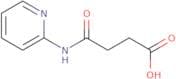
CAS 62134-49-0
:4-Oxo-4-(2-pyridinylamino)butanoic acid
Description:
4-Oxo-4-(2-pyridinylamino)butanoic acid, with the CAS number 62134-49-0, is a chemical compound characterized by its unique structure, which includes a butanoic acid backbone with a ketone and an amino group attached to a pyridine ring. This compound typically exhibits properties associated with both acidic and basic functionalities due to the presence of the carboxylic acid group and the amino group, allowing it to participate in various chemical reactions, such as acid-base interactions. The pyridine moiety contributes to its potential biological activity, as pyridine derivatives are often found in pharmaceuticals and agrochemicals. The compound may also exhibit solubility in polar solvents, which is common for carboxylic acids. Its reactivity can be influenced by the presence of the ketone and amino groups, making it a candidate for further chemical modifications or applications in synthesis. Overall, 4-Oxo-4-(2-pyridinylamino)butanoic acid is of interest in both synthetic chemistry and medicinal chemistry due to its structural features and potential applications.
Formula:C9H10N2O3
InChI:InChI=1S/C9H10N2O3/c12-8(4-5-9(13)14)11-7-3-1-2-6-10-7/h1-3,6H,4-5H2,(H,13,14)(H,10,11,12)
InChI key:InChIKey=BQTOWQQIWDSOTG-UHFFFAOYSA-N
SMILES:N(C(CCC(O)=O)=O)C1=CC=CC=N1
Synonyms:- 3-[(Pyridin-2-yl)carbamoyl]propanoic acid
- 4-Oxo-4-(2-Pyridinylamino)Butanoic Acid
- 4-Oxo-4-(2-Pyridylamino)Butanoic Acid
- Butanoic acid, 4-oxo-4-(2-pyridinylamino)-
- N-(2-Pyridyl)-3-carboxypropanamide
- Succinamic acid, N-2-pyridyl-
Sort by
Purity (%)
0
100
|
0
|
50
|
90
|
95
|
100
Found 2 products.
4-Oxo-4-(pyridin-2-ylamino)butanoic acid
CAS:4-Oxo-4-(pyridin-2-ylamino)butanoic acid is an amide compound that is synthesized by reacting a pyridine with butanoic acid. This heterocyclic compound has been shown to have magnetic properties and it can be used as a synthon to generate other heterocyclic compounds. 4-Oxo-4-(pyridin-2-ylamino)butanoic acid can be oxidized to form the nitrate salt. The square planar geometry of this molecule displays four chiral centers, which gives it the ability to bind to metal ions in order to form complexes. This chemical is also known as a ligand, because it binds reversibly with a metal ion, such as copper or silver.Formula:C9H10N2O3Purity:Min. 95%Molecular weight:194.19 g/mol