CAS 6214-47-7
:Ethyl 4-chloro-5-pyrimidineacetate
Description:
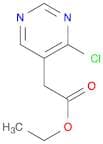
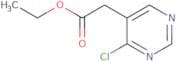
Ethyl 4-chloro-5-pyrimidineacetate, with the CAS number 6214-47-7, is an organic compound that belongs to the class of pyrimidine derivatives. It features a pyrimidine ring substituted with a chloro group and an ethyl acetate moiety. This compound is typically characterized by its moderate solubility in organic solvents, such as ethanol and dichloromethane, while being less soluble in water due to its hydrophobic nature. Ethyl 4-chloro-5-pyrimidineacetate is often utilized in synthetic organic chemistry, particularly in the development of pharmaceuticals and agrochemicals, owing to its potential biological activity. The presence of the chloro substituent can enhance its reactivity, making it a valuable intermediate in various chemical reactions, including nucleophilic substitutions and coupling reactions. Safety data indicates that, like many organic compounds, it should be handled with care, using appropriate personal protective equipment to avoid inhalation or skin contact. Overall, its unique structure and reactivity profile make it an interesting compound for further research and application in chemical synthesis.
Formula:C8H9ClN2O2
InChI:InChI=1S/C8H9ClN2O2/c1-2-13-7(12)3-6-4-10-5-11-8(6)9/h4-5H,2-3H2,1H3
InChI key:InChIKey=HEDARYMFTQTCTI-UHFFFAOYSA-N
SMILES:C(C(OCC)=O)C=1C(Cl)=NC=NC1
Synonyms:- Ethyl 4-chloro-5-pyrimidineacetate
- Ethyl 2-(4-chloropyrimidin-5-yl)acetate
- 5-Pyrimidineacetic acid, 4-chloro-, ethyl ester
- (4-Chloro-pyrimidin-5-yl)-acetic acid ethyl ester
Sort by
Purity (%)
0
100
|
0
|
50
|
90
|
95
|
100
Found 3 products.
4-Chloro-5-pyrimidineacetic acid ethyl ester
CAS:Formula:C8H9ClN2O2Purity:95%Color and Shape:LiquidMolecular weight:200.6223Ethyl 2-(4-chloropyrimidin-5-yl)acetate
CAS:Ethyl 2-(4-chloropyrimidin-5-yl)acetate is a synthetic chemical compound that belongs to the family of aromatic compounds and has been shown to be catalytic in reducing acetone. The mechanism of this reaction is not yet fully understood, but it is thought to involve a catalytic reduction. In order to test this hypothesis, experimental studies are being conducted to see if the catalytic activity can be replicated.Formula:C8H9ClN2O2Purity:Min. 95%Molecular weight:200.62 g/mol