CAS 62150-48-5
:4-Bromo-2-pyridinecarboxylic acid hydrazide
Description:
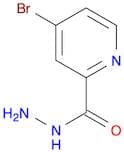
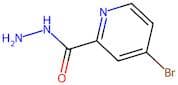
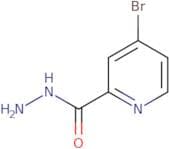
4-Bromo-2-pyridinecarboxylic acid hydrazide is an organic compound characterized by its hydrazide functional group attached to a pyridine ring. The presence of a bromine atom at the 4-position and a carboxylic acid group at the 2-position of the pyridine ring contributes to its unique chemical properties. This compound typically appears as a solid and is soluble in polar solvents, which is common for hydrazides due to their ability to form hydrogen bonds. It may exhibit biological activity, making it of interest in pharmaceutical research. The compound can participate in various chemical reactions, including hydrazone formation and coupling reactions, which are valuable in synthetic organic chemistry. Additionally, its structure allows for potential interactions with biological targets, which could lead to applications in drug development. Safety data should be consulted for handling, as halogenated compounds can pose health risks. Overall, 4-Bromo-2-pyridinecarboxylic acid hydrazide is a versatile compound with potential applications in both research and industry.
Formula:C6H6BrN3O
InChI:InChI=1S/C6H6BrN3O/c7-4-1-2-9-5(3-4)6(11)10-8/h1-3H,8H2,(H,10,11)
InChI key:InChIKey=RTLFVRMZSLFBRU-UHFFFAOYSA-N
SMILES:C(NN)(=O)C1=CC(Br)=CC=N1
Synonyms:- 2-Pyridinecarboxylic acid, 4-bromo-, hydrazide
- 4-Bromo-2-pyridinecarboxylic acid hydrazide
- 4-Bromopicolinic hydrazide
Sort by
Purity (%)
0
100
|
0
|
50
|
90
|
95
|
100
Found 3 products.
4-Bromopicolinohydrazide
CAS:Formula:C6H6BrN3OPurity:95%Color and Shape:SolidMolecular weight:216.03534-Bromopicolinic hydrazide
CAS:4-Bromopicolinic hydrazide is a chemical compound that has antibacterial activity. It is active against bacteria like B. subtilis, P. pneumoniae, and S. aureus as well as fungi such as M. macrophomina and A. fumigatus. 4-Bromopicolinic hydrazide is effective against bacterial strains like phaseolina, K. pneumoniae, and C. sclerotium, but not against E. coli or other Gram-negative bacteria that have been shown to be resistant to ampicillin in vitro studies. It also has antifungal properties which are active against A. fumigatus and M. macrophomina in vitro studies.br>br> 4-Bromopicolinic hydrazide inhibits the synthesis of DNA by binding to the enzyme DNA polymerase and preventing it from making copies of the bacterial DNA during replication.br>br> This drug hasFormula:C6H6BrN3OPurity:Min. 95%Molecular weight:216.04 g/mol