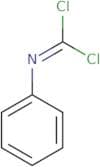
CAS 622-44-6
:N-Phenylcarbonimidic dichloride
Description:
N-Phenylcarbonimidic dichloride, with the CAS number 622-44-6, is an organic compound characterized by its imidic acid derivative structure, featuring a phenyl group attached to a carbon atom that is also bonded to two chlorine atoms. This compound is typically a colorless to pale yellow liquid or solid, depending on its physical state at room temperature. It is known for its reactivity, particularly as a chlorinating agent, and is often used in organic synthesis to introduce the phenylcarbonimidic moiety into various substrates. The presence of the dichloride functional group makes it a potent electrophile, allowing it to participate in nucleophilic substitution reactions. Safety precautions are essential when handling this compound, as it can be corrosive and may pose health hazards upon exposure. Proper storage in a cool, dry place, away from moisture and incompatible substances, is crucial to maintain its stability and prevent degradation.
Formula:C7H5Cl2N
InChI:InChI=1S/C7H5Cl2N/c8-7(9)10-6-4-2-1-3-5-6/h1-5H
InChI key:InChIKey=TTWWZVGVBRPHLE-UHFFFAOYSA-N
SMILES:N(=C(Cl)Cl)C1=CC=CC=C1
Synonyms:- (Phenylimino)carbonyl dichloride
- 1,1-Dichloro-N-phenylmethanimine
- Benzenamine, N-(dichloromethylene)-
- Carbonic dichloride, (phenylimino)-
- Carbonimidic dichloride, N-phenyl-
- Carbonimidic dichloride, phenyl-
- Dichloro(phenylimino)methane
- Imidocarbonyl chloride, phenyl-
- N-(Phenylimino)phosgene
- N-(dichloromethylene)aniline
- N-Phenylcarbimide dichloride
- N-Phenylcarbonimidic dichloride
- N-Phenylimidophosgene
- N-Phenylimidoyl dichloride
- N-Phenyliminocarbonyl dichloride
- NSC 2051
- Phenyl carbylamine chloride
- Phenylcarbonimidic Dichloride
- Phenylimidocarbonyl chloride
- Phenylisonitrile dichloride
- See more synonyms
Sort by
Purity (%)
0
100
|
0
|
50
|
90
|
95
|
100
Found 1 products.
Phenyl isocyanide dichloride
CAS:Controlled ProductPhenyl isocyanide dichloride (PIC) is a chemical compound that has been shown to have antihypertensive activity. PIC binds to the receptor site of the angiotensin II receptor, which inhibits the binding of angiotensin II to this receptor. PIC also has been shown to produce x-ray crystal structures and inhibit chemical reactions in which alkoxy radicals are formed. The ability of PIC to inhibit these chemical reactions may be due to its ability to bind with high affinity at the receptor site for the angiotensin II receptor, thereby preventing it from binding with an angiotensin II molecule. This prevents activation of the enzyme that catalyzes the reaction and leads to inhibition of the chemical reaction. PIC also has been shown as a potential treatment for autoimmune diseases such as multiple sclerosis, rheumatoid arthritis and psoriasis. It has been shown that PIC can reduce inflammation by inhibiting an enzyme known as p-Formula:C7H5Cl2NPurity:Min. 95%Molecular weight:174.03 g/mol