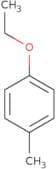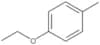
CAS 622-60-6
:1-Ethoxy-4-methylbenzene
Description:
1-Ethoxy-4-methylbenzene, also known as p-ethoxy-toluene, is an organic compound characterized by its aromatic structure, which consists of a benzene ring substituted with an ethoxy group (-OCH2CH3) and a methyl group (-CH3) at the para positions. This compound is a colorless to pale yellow liquid with a pleasant aromatic odor. It is moderately soluble in water but more soluble in organic solvents such as ethanol and ether. The presence of both the ethoxy and methyl groups influences its chemical reactivity, making it a useful intermediate in organic synthesis and various chemical reactions, including electrophilic aromatic substitution. Additionally, 1-ethoxy-4-methylbenzene exhibits properties typical of aromatic compounds, such as stability and resonance. It is important to handle this substance with care, as it may pose health risks if inhaled or ingested, and appropriate safety measures should be taken during its use in laboratory or industrial settings.
Formula:C9H12O
InChI:InChI=1S/C9H12O/c1-3-10-9-6-4-8(2)5-7-9/h4-7H,3H2,1-2H3
InChI key:InChIKey=WSWPHHNIHLTAHB-UHFFFAOYSA-N
SMILES:O(CC)C1=CC=C(C)C=C1
Synonyms:- Phenetole, p-methyl-
- 1-Ethoxy-4-methylbenzene
- 4-Methylphenetole
- p-Methylphenetole
- Benzene, 1-ethoxy-4-methyl-
Sort by
Purity (%)
0
100
|
0
|
50
|
90
|
95
|
100
Found 1 products.
1-Ethoxy-4-methylbenzene
CAS:1-Ethoxy-4-methylbenzene (EMB) is a chemical intermediate that can be used to produce methanesulfonate, an intermediate in the synthesis of pharmaceuticals. It is a colorless liquid with a boiling point of 119 degrees Celsius and a molecular weight of 130.11. The yield of EMB varies depending on the conditions used, but it is typically between 33% and 75%. Kinetics studies have been conducted using termini, which are dyes that react with the carbonyl group on EMB to produce fluorescent products. The kinetics can be seen through microscopy and high-performance liquid chromatography techniques. Nitrate has been shown to be a good catalyst for this reaction mechanism, which involves the formation of an alkyl radical from the splitting of water molecules and the oxidation of metoprolol by nitrate radicals. High concentrations are needed for this reaction to occur because metoprolol is unstable at low concentrations.BR>Formula:C9H12OPurity:Min. 95%Molecular weight:136.19 g/mol