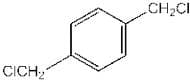
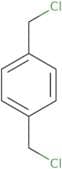
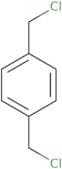
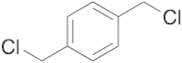
CAS 623-25-6
:α,α′-Dichloro-p-xylene
- 1,4-Bis(chloromethyl)benzene
- 1,4-Di(chloromethyl)benzene
- 1-(Dichloromethyl)-4-Methylbenzene
- 4-(Chloromethyl)benzyl chloride
- Benzene, 1,4-bis(chloromethyl)-
- Nsc 36976
- p-Bis(chloromethyl)benzene
- p-Chloromethylbenzyl chloride
- p-Di(chloromethyl)benzene
- p-Dichloroxylylene
- p-Xylene, α,α'-dichloro-
- p-Xylene-α,α'-dichloride
- p-Xylylene dichloride
- Α-Α'-Dicloro-P-Xileno
- α,α'-Dichlor-p-xylol
- α,α'-Dichloro-p-xylene
- See more synonyms
p-Xylylene dichloride, 98%
CAS:p-Xylylene dichloride is a monomer used in preparation of poly(p-phenylene vinylene(PPV) nanotubes and nanorods by chemical vapor deposition (CVD) polymerization method. It was used in a study to investigate the effect of CVD monomer selection and reaction conditions on the resulting PPV polymer laFormula:C8H8Cl2Purity:98%Color and Shape:White to pale yellow, Crystals or powder or crystalline powderMolecular weight:175.051,4-Bis(chloromethyl)benzene
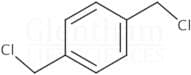
CAS:Formula:C8H8Cl2Purity:98%Color and Shape:SolidMolecular weight:175.05511,4-Bis(chloromethyl)benzene
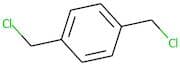
CAS:1,4-Bis(chloromethyl)benzeneFormula:C8H8Cl2Purity:98%Color and Shape: white solidMolecular weight:175.05512g/molα,α'-Dichloro-p-xylene
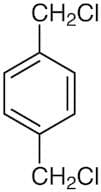
CAS:Formula:C8H8Cl2Purity:>98.0%(GC)Color and Shape:White to Orange to Green powder to crystalMolecular weight:175.05a,a'-Dichloro-p-xylene
CAS:Please enquire for more information about a,a'-Dichloro-p-xylene including the price, delivery time and more detailed product information at the technical inquiry form on this pageFormula:C8H8Cl2Purity:Min. 98 Area-%Molecular weight:175.05 g/mola,a'-Dichloro-p-xylene
CAS:a,a'-Dichloro-p-xylene (DCPX) is a chemical that is used in the production of polymeric materials. It is synthesized by reacting hydrochloric acid with sodium carbonate and quaternizing the resulting a,a'-dichloro-p-xylene with methyl chloride. The reaction mechanism involves the formation of an intermediate dichlorocarbene molecule, which reacts to form DCPX. This process can be accelerated by adding x-ray diffraction data or control analysis to aid in the identification of intermediates.
The reactant can be prepared industrially by reacting chloroform with sodium hydroxide and adding hydrochloric acid to produce dichloromethane (DCM). The resulting DCM can then react with chlorine at high temperature to produce DCPX. In this reaction, water is used as a solvent for the reaction solution and acts as a driving force for the reaction.Formula:C8H8Cl2Purity:Min. 98%Color and Shape:White PowderMolecular weight:175.05 g/mol1,4-Bis(chloromethyl)benzene
CAS:Controlled ProductFormula:C8H8Cl2Color and Shape:White To Off-WhiteMolecular weight:175.06