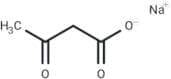
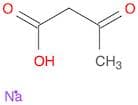
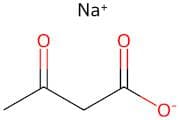
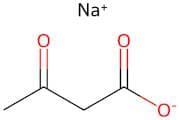
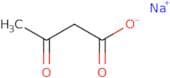
CAS 623-58-5
:Butanoic acid, 3-oxo-, sodium salt (1:1)
Description:
Butanoic acid, 3-oxo-, sodium salt (1:1), also known as sodium 3-oxobutanoate, is a sodium salt derived from 3-oxobutanoic acid, which is a four-carbon dicarboxylic acid. This compound typically appears as a white to off-white crystalline powder and is soluble in water due to the presence of the sodium ion, which enhances its hydrophilicity. It is characterized by its carboxylate functional group, which imparts acidic properties, and the keto group, which contributes to its reactivity in various chemical reactions. This compound is often used in biochemical applications, particularly in metabolic studies and as a potential intermediate in organic synthesis. Its stability under standard conditions makes it suitable for various laboratory applications. Additionally, it may exhibit biological activity, influencing metabolic pathways, although specific effects can vary based on concentration and context. Safety data should be consulted for handling and usage, as with all chemical substances.
Formula:C4H6O3·Na
InChI:InChI=1S/C4H6O3.Na/c1-3(5)2-4(6)7;/h2H2,1H3,(H,6,7);
InChI key:InChIKey=NTXFWAVCYJWUCY-UHFFFAOYSA-N
SMILES:C(C(C)=O)C(O)=O.[Na]
Synonyms:- Acetoacetic acid, sodium salt
- Butanoic acid, 3-oxo-, sodium salt
- Butanoic acid, 3-oxo-,sodium salt (1:1)
- Sodium acetoacetate
Sort by
Purity (%)
0
100
|
0
|
50
|
90
|
95
|
100
Found 7 products.
Acetoacetic acid sodium salt
CAS:Acetoacetic acid sodium salt is a metabolite of non-esterified fatty acids, involved in the development of human diabetes.Formula:C4H5NaO3Purity:≥98%Color and Shape:SolidMolecular weight:124.07Ref: TM-T13528
1mg46.00€2mg62.00€5mg90.00€10mg137.00€25mg216.00€50mg324.00€100mg482.00€500mg1,044.00€Ref: IN-DA003AQQ
1g82.00€5g188.00€10g243.00€25g668.00€50gTo inquire100gTo inquire100mg30.00€250mg46.00€Acetylacetic acid sodium
CAS:Acetylacetate is a metabolite of acetoacetic acid, which is an intermediate in the metabolism of carbohydrates. Acetylacetate is produced by the enzyme acetoacetyl-CoA synthase from two molecules of acetyl-CoA and one molecule of CoA. It is also produced when acetoacetic acid is broken down by the enzyme beta-hydroxybutyric acid dehydrogenase. Acetylacetate has been shown to cause neuronal death in rats when injected into their cerebral ventricles. Acetylacetate may also be involved in energy metabolism, as it can be converted to acetoacetate. This conversion requires ATP and results in the release of adenosine monophosphate (AMP). Acetylacetate also binds to metal chelates, such as EDTA and thiocyanate ions, with high affinity. Acetylacetate has been used as an organic solvent for x-Formula:C4H5NaO3Purity:Min. 95%Color and Shape:PowderMolecular weight:124.07 g/mol