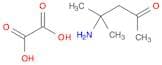
CAS 625-03-6
:1,1-dimethyl-3-oxobutylammonium hydrogen oxalate
Description:
1,1-Dimethyl-3-oxobutylammonium hydrogen oxalate, with the CAS number 625-03-6, is an organic compound that features a quaternary ammonium structure. This substance is characterized by the presence of a dimethylamino group, which contributes to its basicity and potential solubility in polar solvents. The oxobutyl moiety indicates the presence of a ketone functional group, which can influence its reactivity and interactions with other chemical species. As a hydrogen oxalate salt, it contains oxalic acid, which imparts acidity and can participate in various acid-base reactions. The compound is typically used in specialized applications, including organic synthesis and as a reagent in chemical research. Its properties, such as solubility, melting point, and stability, can vary based on environmental conditions and the presence of other substances. Safety data should be consulted for handling and storage, as quaternary ammonium compounds can exhibit varying degrees of toxicity and environmental impact.
Formula:C6H13NO
InChI:InChI=1/C6H13NO/c1-5(8)4-6(2,3)7/h4,7H2,1-3H3
InChI key:InChIKey=PABISXFQAHDPMS-UHFFFAOYSA-N
SMILES:C(C(C)(C)N)C(C)=O.C(C(O)=O)(O)=O
Synonyms:- 2-Pentanone, 4-amino-4-methyl-, ethanedioate (1:1)
- 4-Amino-4-Methylpentan-2-One
- 4-Amino-4-Methylpentan-2-One Ethanedioate (1:1)
- Diacetonamine hydrogen oxalate
- NSC 17567
- 1,1-Dimethyl-3-oxobutylammonium hydrogen oxalate
Sort by
Purity (%)
0
100
|
0
|
50
|
90
|
95
|
100
Found 2 products.
4-Amino-4-methyl-2-pentanone oxalate
CAS:Formula:C8H15NO5Purity:95%Color and Shape:SolidMolecular weight:205.20844-Amino-4-methyl-2-pentanone oxalate
CAS:4-Amino-4-methyl-2-pentanone oxalate is a centrosymmetric, peptidomimetic molecule that has been found to be an adrenergic receptor agonist. It is a chlorine compound that binds to the c1-6 alkyl group. The nature of this residue is cyanamide, which may have a role in the macrocyclic structure. 4-Amino-4-methyl-2-pentanone oxalate has been shown to be an active compound against wild type strains of Escherichia coli and Mycobacterium tuberculosis.Formula:C6H13NO·C2H2O4Purity:Min. 95%Molecular weight:205.21 g/mol