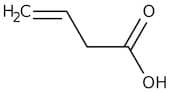
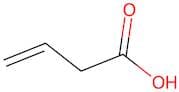
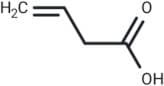
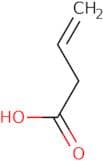
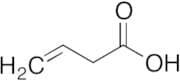
CAS 625-38-7
:3-Butenoic acid
Description:
3-Butenoic acid, also known as crotonic acid, is an unsaturated carboxylic acid characterized by its four-carbon chain with a double bond between the second and third carbon atoms. Its molecular formula is C4H6O2, and it features a carboxylic acid functional group (-COOH) at one end of the chain. This compound is a colorless liquid with a pungent odor and is soluble in water, alcohol, and ether. 3-Butenoic acid is known for its reactivity due to the presence of the double bond, which allows it to participate in various chemical reactions, including polymerization and esterification. It is used in the synthesis of various chemicals, including pharmaceuticals, agrochemicals, and as a building block in organic synthesis. Additionally, it can be involved in the production of polymers and surfactants. Safety considerations include its potential to cause skin and eye irritation, necessitating appropriate handling measures in laboratory and industrial settings.
Formula:C4H6O2
InChI:InChI=1S/C4H6O2/c1-2-3-4(5)6/h2H,1,3H2,(H,5,6)
InChI key:InChIKey=PVEOYINWKBTPIZ-UHFFFAOYSA-N
SMILES:C(C(O)=O)C=C
Synonyms:- 3-Butenoic acid
- Acetic acid, ethenyl-
- But-3-Enoate
- But-3-Enoic Acid
- NSC 44546
- Vinylacetic acid, (3-Butenoic acid)
- β-Butenoic acid
- Vinylacetic acid
Sort by
Purity (%)
0
100
|
0
|
50
|
90
|
95
|
100
Found 8 products.
Vinylacetic acid, 96%
CAS:Vinylacetic acid used in the preparation of strained nitroso Diels-Aldrer adducts which undergo a domino ROC metathesis in the presence of Ru-carbene catalysts and olefins. It is used in the synthesis of polyethylene glycolated boltorn coatings. It was used to study the inhibition of the enzyme-cataFormula:C4H6O2Purity:96%Color and Shape:Liquid, Clear colorless to yellowMolecular weight:86.093-Butenoic acid
CAS:3-Butenoic acid aids in creating 3,6-dihydro-1,2-oxazine for domino metathesis with alkenes.Formula:C4H6O2Color and Shape:SolidMolecular weight:86.093-Butenoic acid
CAS:3-Butenoic acid is a versatile compound that has various applications across different industries. In the field of healthcare, it has been found to be effective in treating bacterial vaginosis, a common vaginal infection caused by an imbalance of bacteria. Additionally, it has shown virologic properties, making it potentially useful in antiviral therapies.
Formula:C4H6O2Purity:Min. 95 Area-%Molecular weight:86.09 g/mol3-Butenoic acid
CAS:3-Butenoic acid is a fatty acid that belongs to the group of short chain carboxylic acids. It is used in detergent compositions where it functions as a cationic surfactant and has a hydroxyl group that can be used for polymerization reactions. 3-Butenoic acid is also used as an analytical reagent, e.g., in electrochemical impedance spectroscopy, in which it has been shown to have phase transition temperature of around 38°C. 3-Butenoic acid can be synthesized by reacting butanol with hydrochloric acid and copper chloride in the presence of a cationic surfactant such as alkyltrimethylammonium chloride or benzalkonium chloride. 3-Butenoic acid also acts as a Jak1 inhibitor and has receptor activity against all types of receptors, including those for histamine, acetylcholine, dopamine, serotonin, and GABA (gamma aminobFormula:C4H6O2Purity:Min. 95 Area-%Color and Shape:Colorless Clear LiquidMolecular weight:86.09 g/molVinylacetic Acid
CAS:Controlled ProductStability Light Sensitive
Applications Vinylacetic Acid can be used as a reagent in the synthesis of 4-Phenyl-3-butenoic Acid which is an in vivo inhibitor of the peptide amidating enzyme peptidylglycine hydroxylase.
Not a dangerous good if item is equal to or less than 1g/ml and there is less than 100g/ml in the package
References Bradbury, A.F., et al.: Eur. J. Biochem., 189, 33 (1990)Formula:C4H6O2Color and Shape:NeatMolecular weight:86.09