CAS 62502-71-0
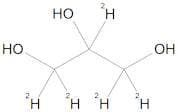
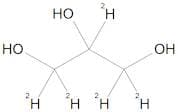
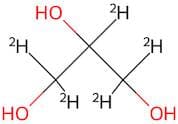
:glycerol-1,1,2,3,3-D5
Description:
Glycerol-1,1,2,3,3-D5, also known as deuterated glycerol, is a stable isotopic form of glycerol where five hydrogen atoms are replaced with deuterium, a heavier isotope of hydrogen. This modification results in a molecular formula similar to that of standard glycerol, but with distinct physical and chemical properties due to the presence of deuterium. Glycerol-1,1,2,3,3-D5 is typically a colorless, odorless, and viscous liquid, exhibiting hygroscopic behavior, meaning it can absorb moisture from the air. It is soluble in water and alcohols, making it useful in various applications, including as a solvent, humectant, and in biochemical research. The deuterated form is particularly valuable in nuclear magnetic resonance (NMR) spectroscopy and other analytical techniques, as it allows for the study of molecular dynamics and interactions without interference from hydrogen signals. Additionally, its use in metabolic studies can provide insights into biochemical pathways and mechanisms.
Sort by
Purity (%)
0
100
|
0
|
50
|
90
|
95
|
100
Found 6 products.
Glycerol-1,1,2,3,3-d5
CAS:Formula:(HOCD2)2CDOHPurity:98 atom % DColor and Shape:Colorless Viscous LiquidMolecular weight:97.07873Glycerol-d5
CAS:Controlled ProductApplications Labelled Glycerol (G598400). Glycerol is used both in sample preparation and gel formation for polyacrylamide gel electrophoresis. Glycerol (5-10%) increases the density of a sample so that the sample will layer at the bottom of a gel’s sample well. Glycerol is also used to aid in casting gradient gels and as a protein stabilizer and storage buffer component.
References Bartsch, W., et al.: Arzeim.-Forsch., 26, 1581 (1976),Formula:C32H5H3O3Color and Shape:ColourlessMolecular weight:97.12GLYCEROL-1,1,2,3,3-D5
CAS:Formula:C3H3D5O3Purity:98%,98atom%DColor and Shape:LiquidMolecular weight:97.1246