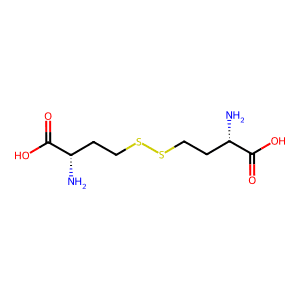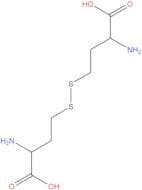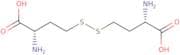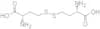
CAS 626-72-2
:L-Homocystine
- (2S,2′S)-4,4′-Dithiobis[2-aminobutanoic acid]
- (H-HoCys-OH)2
- <span class="text-smallcaps">L</span>-Homocystine
- Butanoic acid, 4,4′-dithiobis[2-amino-, (2S,2′S)-
- Butanoic acid, 4,4′-dithiobis[2-amino-, [S-(R*,R*)]-
- Butyric acid, 4,4′-dithiobis[2-amino-, <span class="text-smallcaps">L</span>-
- L-Homocystine
- Butyric acid, 4,4′-dithiobis[2-amino-, L-
(H-Homocys-OH)₂
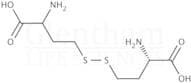
CAS:The spontaneous oxidation of plasma homocysteine yields homocystine, which is scarcely soluble at neutral pH. The homocystine microcrystals damage the endothelial tissue which increases the risk of vascular diseases.Formula:C8H16N2O4S2Purity:> 99%Color and Shape:White PowderMolecular weight:268.36(2S)-2-Amino-4-[[(3S)-3-amino-4-hydroxy-4-oxo-butyl]disulfanyl]butanoic acid
CAS:(2S)-2-Amino-4-[[(3S)-3-amino-4-hydroxy-4-oxo-butyl]disulfanyl]butanoic acidFormula:C8H16N2O4S2Purity:98%Color and Shape: off-white to light yellow solidMolecular weight:268.35g/molL-Homocystine
CAS:Homocystine briefly forms before turning into cystathionine via vitamin B6; linked to schizophrenia and neural tube defects; folic acid lowers risk.Formula:C8H16N2O4S2Purity:99.79%Color and Shape:SolidMolecular weight:268.35L-Homocystine
CAS:Controlled ProductApplications Increased levels lead to hyperhomocysteinemia; a cardiovascular risk factor in prediction of coronary heart disease as well as being associated with congenital birth defects, pregnancy complications and cancer.
References Geisel, J. et al.: Clin. Chem. Lab. Med., 41, 1513 (2003); Geisel, J. et al.: Clin. Chem. Lab. Med., 41, 1513 (2003);Formula:C8H16N2O4S2Color and Shape:NeatMolecular weight:268.35L-Homocystine
CAS:Oxidized member of L-homocysteine/L-homocystine pairFormula:C8H16N2O4S2Purity:(Nitrogen Content) Min. 98%Color and Shape:PowderMolecular weight:268.36 g/molH-HoCys-OH
CAS:M06106 - H-HoCys-OH
Formula:C8H16N2O4S2Purity:95%Color and Shape:SolidMolecular weight:268.35L-Homocystine
CAS:L-Homocystine is a chemical compound that is used as a research chemical and a speciality chemical. It is an amino acid that can be obtained from the degradation of methionine, cysteine, and serine. L-Homocystine has been found to have many uses in the pharmaceutical industry, including as a building block or intermediate for complex compounds such as antibiotics, antihypertensive drugs, and anticonvulsants. L-Homocystine can also be used as a reagent in organic synthesis reactions. This compound is not only useful for research purposes but can also be used in the manufacturing of high quality products.
Formula:C8H16N2O4S2Molecular weight:268.36 g/molRef: 3D-H-3040
Discontinued product
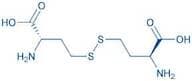

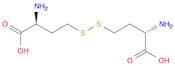


![(2S)-2-Amino-4-[[(3S)-3-amino-4-hydroxy-4-oxo-butyl]disulfanyl]butanoic acid](/_next/image/?url=https%3A%2Fstatic.cymitquimica.com%2Fproducts%2F54%2Fthumb%2FOR480428.jpg&w=3840&q=75)