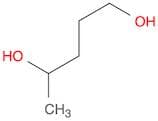
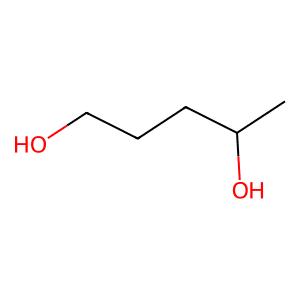
CAS 626-95-9
:1,4-Pentanediol
- 1,4-Dihydroxy-1-methylbutane
- 1,4-Dihydroxypentane
- 2,5-Pentanediol
- 4-Hydroxy-1-pentanol
- Ai3-08028
- Pentane-1,4-diol
- 1,4-Pentanediol
PENTANE-1,4-DIOL
CAS:Formula:C5H12O2Purity:95%Color and Shape:Liquid, No data available.Molecular weight:104.1491,4-Pentanediol
CAS:Stability Hygroscopic
Applications 1,4-Pentanediol is a useful synthetic intermediate. It was used in the preparation of poly(ortho ester). 1,4-Pentanediol on dehydration in water at 573K yields five-membered ether, 2-methyltetrahydrofuran.
References Heller, J., et al.: J. Controlled Release, 78, 133 (2002); Yamaguchi, A., et al.: green Chem., 11, 48 (2009)Formula:C5H12O2Color and Shape:Colourless OilyMolecular weight:104.1481,4-Pentanediol
CAS:1,4-Pentanediol is a diol that is used in the manufacture of polyurethanes and other organic compounds. It is produced by the oxidation of benzene with oxygen in the presence of a catalyst such as manganese dioxide. 1,4-Pentanediol can also be prepared from levulinic acid or glycol ethers. 1,4-Pentanediol reacts with an aromatic hydrocarbon in the presence of a homogeneous catalyst to produce viscosity and polycarboxylic acids. The reaction mechanism for this process begins with the addition of water to form hydrogen peroxide and acetaldehyde. Hydrogen peroxide then reacts with an aromatic hydrocarbon to produce glycol ether and hydroxy group. The hydroxyl group then reacts with another aromatic hydrocarbon to produce viscosity and polycarboxylic acid. The reaction products are isolated by distillation or vacuum evaporation, after which they are purified by recrystall
Formula:C5H12O2Purity:Min. 95%Color and Shape:Colorless Clear LiquidMolecular weight:104.15 g/molRef: 3D-FP46066
Discontinued product