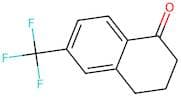
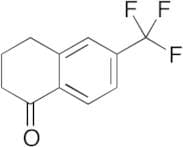
CAS 62620-71-7
:1(2H)-Naphthalenone,3,4-dihydro-6-(trifluoromethyl)-
Description:
1(2H)-Naphthalenone, 3,4-dihydro-6-(trifluoromethyl)-, with CAS number 62620-71-7, is an organic compound characterized by its naphthalene backbone, which is a fused bicyclic aromatic hydrocarbon. This compound features a ketone functional group at the 1-position and a trifluoromethyl group at the 6-position, contributing to its unique chemical properties. The presence of the trifluoromethyl group enhances its lipophilicity and can influence its reactivity and biological activity. The dihydro configuration indicates that the compound has two additional hydrogen atoms, which may affect its stability and reactivity compared to fully aromatic naphthalenones. This compound may exhibit interesting properties such as fluorescence or potential applications in pharmaceuticals, agrochemicals, or materials science due to its structural characteristics. Its synthesis and reactivity can be influenced by the presence of the trifluoromethyl group, making it a subject of interest in organic chemistry research.
Formula:C11H9F3O
Synonyms:- 6-(Trifluoromethyl)-1-tetralone
Sort by
Purity (%)
0
100
|
0
|
50
|
90
|
95
|
100
Found 4 products.
6-(Trifluoromethyl)-2,3,4-trihydronaphthalen-1-one
CAS:Formula:C11H9F3OPurity:95%Color and Shape:LiquidMolecular weight:214.18383,4-Dihydro-6-(trifluoromethyl)-1(2H)-naphthalenone
CAS:3,4-Dihydro-6-(trifluoromethyl)-1(2H)-naphthalenonePurity:95%Molecular weight:214.18g/mol6-(TRIFLUOROMETHYL)-3,4-DIHYDRO-2H-NAPHTHALEN-1-ONE
CAS:Formula:C11H9F3OPurity:95%Molecular weight:214.1876-Trifluoromethyltetralin-1-one
CAS:Controlled ProductApplications 6-Trifluoromethyltetralin-1-one is derived from 4-Bromobenzotrifluoride (B680525), which is an aromatic compound that is used as a reagent to synthesize Bergenin (B318650), a compound that originates in Mallotus japonicus that exhibits hepatoprotective and antioxidant effects. 4-Bromobenzotrifluoride is also used as a reagent to prepare (±)-Preclamol, a partial dopamine D2 agonist that is used to treat Parkinson’s disease.
References Lim, H., et al.: Pharmacology, 63, 71 (2001); Parkan, K., et al.: Chem. Eur. J., 20, 4414 (2014); Pirtosek, Z., et al.: Clin. Neuro., 16, 550 (1993); Takahashi, H., et al.: Bioorg. Med. Chem., 11, 1781 (2003); Vasdev, N., et al.: Synapse, 60, 314 (2006)Formula:C11H9F3OColor and Shape:NeatMolecular weight:214.184