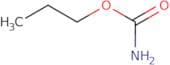
CAS 627-12-3
:Propyl carbamate
Description:
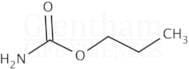
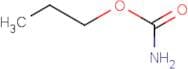
Propyl carbamate, with the CAS number 627-12-3, is an organic compound classified as a carbamate. It is characterized by the presence of a propyl group attached to a carbamate functional group, which consists of a carbonyl (C=O) bonded to a nitrogen atom (N) that is also connected to an alkyl or aryl group. This compound typically appears as a colorless to pale yellow liquid or solid, depending on its purity and form. Propyl carbamate is known for its low toxicity and is often used in various applications, including as a solvent, in the synthesis of pharmaceuticals, and as an intermediate in organic chemistry. It exhibits moderate solubility in water and is more soluble in organic solvents. The compound is stable under normal conditions but may decompose upon exposure to strong acids or bases. Its properties make it useful in research and industrial applications, although safety precautions should be taken to handle it properly due to potential irritant effects.
Formula:C4H9NO2
InChI:InChI=1S/C4H9NO2/c1-2-3-7-4(5)6/h2-3H2,1H3,(H2,5,6)
InChI key:InChIKey=YNTOKMNHRPSGFU-UHFFFAOYSA-N
SMILES:O(C(N)=O)CCC
Synonyms:- Ai3-28287
- Brn 1743059
- Carbamic acid, propyl ester
- Ccris 538
- Hsdb 2588
- Nsc 4855
- Propyl urethane
- Propylester kyseliny karbaminove
- Propylester kyseliny karbaminove [Czech]
- n-Propyl carbamate
- Propyl carbamate
- See more synonyms
Sort by
Purity (%)
0
100
|
0
|
50
|
90
|
95
|
100
Found 7 products.
N-Propylcarbamate
CAS:N-PropylcarbamateFormula:C4H9NO2Purity:97%Color and Shape: white solidMolecular weight:103.12g/molCarbamic Acid Propyl Ester
CAS:Controlled ProductApplications A metabolite of alkyl carbamate (ethyl or propyl).
References Muller, J.P., et al.: J. Chim. Phys. Physicochim. Biol., 71, 893 (1974),Formula:C4H9NO2Color and Shape:NeatMolecular weight:103.12N-Propyl carbamate
CAS:N-Propyl carbamate is a fluorescent detector that is used to detect β-aminopropionic acid. It reacts with the 3-mercaptopropionic acid present in the skin tumor cells, causing them to fluoresce. This reaction can be detected by a fluorescence detector. The method of detection of anthelmintic drugs using N-propyl carbamate has been developed using chromatographic and spectrophotometric methods for the separation and identification of carboethoxy groups. The mutant strain was found to be resistant to this drug, so it is not considered to be an effective anthelmintic drug.Formula:C4H9NO2Purity:Min. 95%Molecular weight:103.12 g/mol