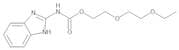
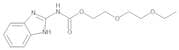
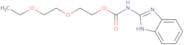
CAS 62732-91-6
:2-(2-ethoxyethoxy)ethyl 1H-benzimidazol-2-ylcarbamate
- 1H-Benzimidazol-2-yl-carbamic acid 2-(2-ethoxyethoxy)ethyl ester
- 1H-Benzimidazol-2-ylcarbamate de 2-(2-éthoxyéthoxy)éthyle
- 2-(2-Ethoxyethoxy)ethyl benzimidazol-2-ylcarbamate
- 2-(2-Ethoxyethoxy)ethyl-1H-benzimidazol-2-ylcarbamat
- 62732-91-6
- Carbamic acid, 1H-benzimidazol-2-yl-, 2-(2-ethoxyethoxy)ethyl ester
- Carbamic acid, N-1H-benzimidazol-2-yl-, 2-(2-ethoxyethoxy)ethyl ester
- Debacarb
Debacarb
CAS:Controlled ProductApplications Debacarb (CAS# 62732-91-6) is a useful research chemical compound.
Formula:C14H19N3O4Color and Shape:NeatMolecular weight:293.32Debacarb
CAS:Debacarb is a subtilis mutant strain that produces the active substances debacarb and debacin. Debacarb inhibits the mitochondrial cytochrome b-245, which is an enzyme in the electron transport chain of mitochondria. It also inhibits bacterial growth by binding to nicotinic acetylcholine, which is an enzyme involved in the synthesis of bacterial cell walls. The target enzymes for this compound are not yet known. The bacterium Agrobacterium tumefaciens was found to be sensitive to Debacarb, but resistant strains were also obtained. Debacarb has been used as an agrochemical against bacterial strains such as Pseudomonas syringae and Erwinia carotovora. The effective dose for Debacarb varies depending on the bacterial strain. The most common effective doses are between 2 and 5 ppm, but higher concentrations may be needed against some bacteria.br> Debacarb can inhibit polymerase chain reactions, which
Formula:C14H19N3O4Purity:Min. 95%Molecular weight:293.32 g/mol