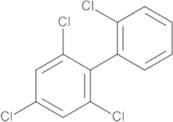
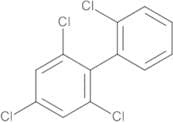
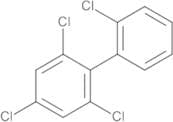
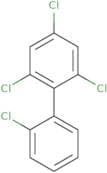
CAS 62796-65-0
:2,2',4,6-tetrachlorobiphenyl
Description:
2,2',4,6-Tetrachlorobiphenyl, with the CAS number 62796-65-0, is a chlorinated biphenyl compound that belongs to the class of polychlorinated biphenyls (PCBs). This substance is characterized by its two connected phenyl rings, each substituted with chlorine atoms at specific positions, which significantly influences its chemical properties. It is typically a solid at room temperature and exhibits low volatility, making it persistent in the environment. 2,2',4,6-Tetrachlorobiphenyl is hydrophobic, leading to its accumulation in biological systems and potential for bioaccumulation in the food chain. The compound is known for its stability and resistance to degradation, which raises concerns regarding its environmental impact and toxicity. It has been associated with various health risks, including endocrine disruption and potential carcinogenic effects. Due to these characteristics, the use of PCBs, including 2,2',4,6-tetrachlorobiphenyl, has been heavily regulated or banned in many countries.
Formula:C12H6Cl4
InChI:InChI=1/C12H6Cl4/c13-7-5-10(15)12(11(16)6-7)8-3-1-2-4-9(8)14/h1-6H
SMILES:c1ccc(c(c1)c1c(cc(cc1Cl)Cl)Cl)Cl
Synonyms:- 1,1'-Biphenyl, 2,2',4,6-Tetrachloro-
- 2,2',4,6-Pcb
- 2,2',4,6-Tetrachloro-1,1'-biphenyl
- 62796-65-0
- 2,2',4,6-Tetrachlorobiphenyl
Sort by
Purity (%)
0
100
|
0
|
50
|
90
|
95
|
100
Found 4 products.
PCB No. 50 10 µg/mL in Isooctane
CAS:Controlled ProductFormula:C12H6Cl4Color and Shape:Single SolutionMolecular weight:291.99PCB No. 50 100 µg/mL in Hexane
CAS:Controlled ProductFormula:C12H6Cl4Color and Shape:Single SolutionMolecular weight:291.992,2',4,6-Tetrachlorobiphenyl
CAS:Controlled Product2,2',4,6-Tetrachlorobiphenyl (PCB) is a polychlorinated biphenyl that is released into the environment from industrial emissions. PCBs are found in air and water and accumulate in fish and other organisms. PCBs are also found in soil. They can be absorbed through the skin or by inhalation of contaminated air or dust. In humans, PCBs have been shown to alter cellular signaling pathways that control cell growth and proliferation. These effects may be due to their ability to modulate glycol metabolism, inhibit p38 mitogen activated protein kinase activation, and interfere with prostaglandin synthesis.Formula:C12H6Cl4Purity:Min. 95%Molecular weight:292 g/mol