CAS 628-48-8
:trans-Glutaconic acid
Description:
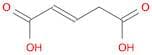
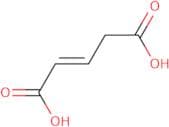
Trans-glutaconic acid is an organic compound characterized by its structure as a dicarboxylic acid, specifically an unsaturated derivative of glutamic acid. It features a trans configuration around its double bond, which distinguishes it from its cis counterpart. The molecular formula of trans-glutaconic acid is C5H6O4, and it contains two carboxylic acid functional groups (-COOH) that contribute to its acidic properties. This compound is typically found in a crystalline form and is soluble in water, which enhances its reactivity in various chemical processes. Trans-glutaconic acid is of interest in biochemical research, particularly in studies related to amino acid metabolism and potential applications in pharmaceuticals. Its structural characteristics allow it to participate in various chemical reactions, including esterification and decarboxylation. Additionally, it may serve as an intermediate in the synthesis of other organic compounds. Overall, trans-glutaconic acid is a significant compound in organic chemistry with implications in both biological systems and synthetic applications.
Formula:C5H6O4
InChI:InChI=1S/C5H6O4/c6-4(7)2-1-3-5(8)9/h1-2H,3H2,(H,6,7)(H,8,9)/b2-1+
InChI key:InChIKey=XVOUMQNXTGKGMA-OWOJBTEDSA-N
SMILES:C(\CC(O)=O)=C/C(O)=O
Synonyms:- 2-Pentenedioic acid, (E)-
- 2-Pentenedioic acid, (2E)-
- Glutaconic acid, (E)-
- (2E)-2-Pentenedioic acid
- Glutaconic acid, trans-
Sort by
Purity (%)
0
100
|
0
|
50
|
90
|
95
|
100
Found 4 products.
trans-Glutaconic Acid
CAS:Controlled Product<p>Applications trans-Glutaconic Acid is used in the synthesis of iso and azokainoids which act as agonists for glutamate receptors. E-isomer of Glutaconic Acid (G596945).<br>References Felluga, F. et al.: Chirality, 24, 112 (2012); Wang, W. et al.: Bioorg. Med. Chem. Lett., 23, 1949 (2013);<br></p>Formula:C5H6O4Color and Shape:White To Light BrownMolecular weight:130.1(E)-2-Pentenedioic acid
CAS:<p>(E)-2-Pentenedioic acid is a model system for the study of the mechanism of infectious diseases. The hydroxyl group in (E)-2-pentenedioic acid can undergo oxidation and reduction reactions, which are important for cell metabolism. This reaction can be used to produce malonic acid and tiglic acid, which are precursors of amino acids. (E)-2-Pentenedioic acid has been shown to cause neuronal death by inhibiting energy metabolism, leading to decreased levels of ATP and increased intracellular sodium ion concentration. It also leads to an increase in glutamate, which has been shown to induce tubule cells in the kidney to release potassium ions into the urine.</p>Purity:Min. 95%trans-Glutaconic acid
CAS:<p>trans-Glutaconic acid</p>Purity:95%Color and Shape:SolidMolecular weight:130.10g/mol