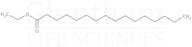
CAS 628-97-7
:Ethyl palmitate
Description:
Ethyl palmitate, with the CAS number 628-97-7, is an ester formed from the reaction of palmitic acid and ethanol. It is a colorless to pale yellow liquid at room temperature, exhibiting a mild, fatty odor. Ethyl palmitate is insoluble in water but soluble in organic solvents such as ethanol and ether. This compound is known for its emollient properties, making it a common ingredient in cosmetics and personal care products, where it serves as a skin-conditioning agent. Additionally, it is utilized in the food industry as a flavoring agent and in the formulation of various food products. Ethyl palmitate has a relatively low toxicity profile, which contributes to its safety in consumer applications. Its chemical structure consists of a long hydrocarbon chain, which contributes to its hydrophobic characteristics and influences its behavior in different environments. Overall, ethyl palmitate is valued for its functional properties in both industrial and consumer applications.
Formula:C18H36O2
InChI:InChI=1S/C18H36O2/c1-3-5-6-7-8-9-10-11-12-13-14-15-16-17-18(19)20-4-2/h3-17H2,1-2H3
InChI key:InChIKey=XIRNKXNNONJFQO-UHFFFAOYSA-N
SMILES:C(CCCCCCCCCCCCC)CC(OCC)=O
Synonyms:- Ethyl Palmitate
- Ethyl hexadecanoate
- Ethylpalmitat
- Nsc 8918
- Palmitate d'ethyle
- Palmitate, Ethyl
- Palmitato De Etilo
- Palmitic acid, ethyl ester
- Palmitinsaeure-Aethylester
- Ethyl palmitate, (Ethyl hexadecanoate
- Palmitic aci
- See more synonyms
Sort by
Purity (%)
0
100
|
0
|
50
|
90
|
95
|
100
Found 16 products.
Ethyl Palmitate
CAS:Formula:C18H36O2Purity:>97.0%(GC)Color and Shape:White or Colorless to Light yellow powder to lump to clear liquidMolecular weight:284.48Ethyl palmitate, 97%
CAS:Ethyl palmitate acts as a lubricant on the skin’s surfaces in order to get a soft and smooth appearance. It increases cytosolic Ca2+ concentration leading to pancreatic acinar cell injury due to excessive consumption of ethanol. This Thermo Scientific Chemicals brand product was originally part of tFormula:CH3(CH2)14CO2CH2CH3Purity:97%Color and Shape:White or clear colorless, Fused solid or liquid as meltMolecular weight:284.48Ethyl Palmitate
CAS:Palmitic acid, stearic acid, their salts and estrsFormula:C18H36O2Color and Shape:SolidMolecular weight:284.27153Ethyl Hexadecanoate
CAS:Formula:C18H36O2Purity:>99%Color and Shape:Colorless CrystalsMolecular weight:284.48Hexadecanoic acid-ethyl ester
CAS:Controlled ProductFormula:C18H36O2Color and Shape:NeatMolecular weight:284.48Ethyl palmitate
CAS:Ethyl palmate (palmitic acid ethyl ester) is a type of fatty acid ethyl ester (FAEE). Ethyl palmate can be used as a hair and skin conditioner.Formula:C18H36O2Purity:98.93% - 99.87%Color and Shape:LiquidMolecular weight:284.48Ethyl Palmitate
CAS:Applications A fatty acid found in Amaranth oil; it shows inhibitory activity.
References Fidler, N., et al.: J. Lipid Res., 41, 1376 (2000), Yang, T., et al.: Food Chem., 80, 473 (2003), Gamel, T., et al.: J. Food Lipids, 14, 323 (2007),Formula:C18H36O2Color and Shape:Off-WhiteMolecular weight:284.48Ethyl palmitate
CAS:Ethyl palmitate is a glycol ether that belongs to the group of esters. It has been shown to have biochemical properties and natural compounds such as caproic acid and ethyl palmitate. The liquid form of ethyl palmitate is clear, colorless, and odorless with a density of 1.065 g/mL at 20°C. Ethyl palmitate is soluble in ethanol, diethylether, benzene, chloroform, carbon tetrachloride, acetic acid ethyl ester, acetone, ethyl acetate, dichloromethane, and methanol. Ethyl palmitate can be used as a model system or analytical method for the identification of other lipids in biological samples.Formula:C18H36O2Purity:Min. 95%Molecular weight:284.48 g/mol