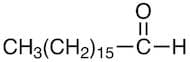
CAS 629-90-3
:Heptadecanal
Description:
Heptadecanal, also known as n-heptadecanal, is a long-chain aliphatic aldehyde with the molecular formula C17H34O. It is characterized by a straight-chain structure consisting of 17 carbon atoms and a terminal aldehyde functional group (-CHO). This compound is typically a colorless to pale yellow liquid at room temperature and has a waxy texture. Heptadecanal is insoluble in water but soluble in organic solvents such as ethanol and ether. It has a distinctive fatty odor, which is common among long-chain aldehydes. Heptadecanal is used in various applications, including as a flavoring agent, fragrance component, and in the synthesis of other organic compounds. Additionally, it can be found in certain natural sources, such as plant oils and animal fats. Its properties make it relevant in both industrial and research contexts, particularly in studies related to lipid chemistry and biochemistry. Safety precautions should be observed when handling this substance, as with many aldehydes, due to potential irritant effects.
Formula:C17H34O
InChI:InChI=1S/C17H34O/c1-2-3-4-5-6-7-8-9-10-11-12-13-14-15-16-17-18/h17H,2-16H2,1H3
InChI key:InChIKey=PIYDVAYKYBWPPY-UHFFFAOYSA-N
SMILES:C(CCCCCCCC=O)CCCCCCCC
Synonyms:- 1-Heptadecanal
- Ai3-24250
- Margaric aldehyde
- n-Heptadecanal
- Heptadecanal
Sort by
Purity (%)
0
100
|
0
|
50
|
90
|
95
|
100
Found 7 products.
Heptadecanal
CAS:Formula:C17H34OPurity:>97.0%(GC)Color and Shape:White to Almost white powder to crystalMolecular weight:254.46Heptadecanal
CAS:Heptadecanal is a long-chain aliphatic aldehyde commonly used in flavor preparation, organic synthesis and biochemical experiments.Formula:C17H34OPurity:99.06%Color and Shape:SolidMolecular weight:254.45n-Heptadecanal
CAS:Controlled ProductStability Air Sensitive, Moisture Sensitive
Applications n-Heptadecanal is one of the volatile components in the essential oil extracts of yaka, a type of tobacco that is native to Bulgaria. n-Heptadecanal is also one of the volatile components from the leaf extracts of Rhus typhina, a plant that displays insecticidal activity towards aphids.
References Alagic, S., et al.: J. Ess. Oil Res., 14, 230 (2002); Beshkov, A.: Econ. Geog., No vol. given, 188 (1940); Davalieva, K., et al.: Diversity, 2, 439 (2010)Formula:C17H34OColor and Shape:NeatMolecular weight:254.45