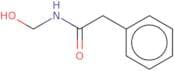
CAS 6291-06-1
:N-(Hydroxymethyl)phenylacetamide
Description:
N-(Hydroxymethyl)phenylacetamide, with the CAS number 6291-06-1, is an organic compound characterized by its amide functional group and a hydroxymethyl substituent on the phenyl ring. This compound typically appears as a solid at room temperature and is soluble in polar solvents due to the presence of the hydroxymethyl group, which can engage in hydrogen bonding. Its molecular structure consists of a phenyl ring attached to an acetamide group, which contributes to its potential biological activity. The hydroxymethyl group enhances its reactivity and may influence its interaction with biological targets. N-(Hydroxymethyl)phenylacetamide may be utilized in various applications, including pharmaceuticals and agrochemicals, owing to its potential as a building block in organic synthesis. Additionally, its properties can be influenced by factors such as pH and temperature, which may affect its stability and reactivity. As with many organic compounds, safety precautions should be taken when handling this substance, as it may pose health risks if ingested or inhaled.
Formula:C9H11NO2
InChI:InChI=1/C9H11NO2/c11-7-10-9(12)6-8-4-2-1-3-5-8/h1-5,11H,6-7H2,(H,10,12)
SMILES:c1ccc(cc1)CC(=NCO)O
Synonyms:- N-(hydroxymethyl)-2-phenylacetamide
- N-(Hydroxymethyl)-phenylacetamide
Sort by
Purity (%)
0
100
|
0
|
50
|
90
|
95
|
100
Found 3 products.
N-(Hydroxymethyl)-2-phenylacetamide
CAS:N-(Hydroxymethyl)-2-phenylacetamidePurity:97%Molecular weight:165.19g/molN-(Hydroxymethyl)-phenylacetamide
CAS:N-(Hydroxymethyl)-phenylacetamide is an organic solvent that is used in the synthesis of certain antibiotics. It is a synthetic compound and can be obtained by reacting toluene with benzene, using a strong acid catalyst such as sulfuric acid. N-(Hydroxymethyl)-phenylacetamide has been used in the synthesis of isoquinolones, which are also antibiotics. This organic solvent can also be used for recrystallization, which is a process that helps purify solids from liquids or liquids from solids. The yield of this reaction is high, making it an efficient way to synthesize these compounds.Formula:C9H11NO2Purity:Min. 95%Molecular weight:165.19 g/mol