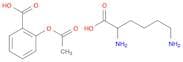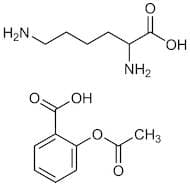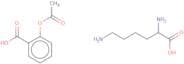
CAS 62952-06-1
:Aspisol
Description:
Aspisol, with the CAS number 62952-06-1, is a chemical compound primarily known for its application in the pharmaceutical industry, particularly as a non-steroidal anti-inflammatory drug (NSAID). It exhibits analgesic, antipyretic, and anti-inflammatory properties, making it useful for treating pain, fever, and inflammation. Aspisol functions by inhibiting the cyclooxygenase (COX) enzymes, which play a crucial role in the synthesis of prostaglandins, compounds that mediate inflammation and pain. The substance is typically administered in various formulations, including tablets and topical applications, and is characterized by its relatively low toxicity profile compared to other NSAIDs. However, like all medications, it may have side effects, including gastrointestinal discomfort and potential cardiovascular risks, particularly with long-term use. Its pharmacokinetics involve absorption, distribution, metabolism, and excretion processes that are essential for determining its efficacy and safety in clinical use. Overall, Aspisol is a significant compound in the realm of pain management and inflammation control.
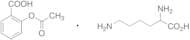
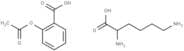
Formula:C9H8O4·C6H14N2O2
InChI:InChI=1S/C9H8O4.C6H14N2O2/c1-6(10)13-8-5-3-2-4-7(8)9(11)12;7-4-2-1-3-5(8)6(9)10/h2-5H,1H3,(H,11,12);5H,1-4,7-8H2,(H,9,10)
InChI key:InChIKey=JJBCTCGUOQYZHK-UHFFFAOYSA-N
SMILES:C(CCCCN)(C(O)=O)N.C(O)(=O)C1=C(OC(C)=O)C=CC=C1
Synonyms:- 2,6-Diaminohexanoic Acid Compound With 2-Acetoxybenzoic Acid (1:1)
- 6-Ammonionorleucine 2-(Acetyloxy)Benzoate
- <span class="text-smallcaps">DL</span>-Lysine acetylsalicylate
- <span class="text-smallcaps">DL</span>-Lysine aspirin salt
- <span class="text-smallcaps">DL</span>-Lysine, mono[2-(acetyloxy)benzoate]
- Acelysin
- Acelysine
- Acetylsalicylic acid <span class="text-smallcaps">DL</span>-lysine salt
- Acetylsalicylic acid dl-lysine salt
- Acetylsalicylic acid lysine salt
- Asalis
- Aspegic
- Aspidol
- Aspirin <span class="text-smallcaps">D</smallcap><smallcap>L</span>-lysine
- Aspirin DL-lysine
- Aspirin Lysine
- Aspirin lysine salt
- Aspirisine
- Aspisol
- Atselizin
- Benzoic acid, 2-(acetyloxy)-, compd. with <span class="text-smallcaps">DL</span>-lysine (1:1)
- Benzoic acid, 2-(acetyloxy)-, compd. with lysine (1:1)
- Cogla
- DL-Lysine acetylsalicylate
- Delgesic
- Egicalm
- Laboprin
- Lysal
- Lysine acetylsalicylate
- Lysine monosalicylate acetate
- Lysine, 2-(acetyloxy)benzoate (1:1)
- Lysine, mono[2-(acetyloxy)benzoate]
- Lysini racemici acetylsalicylase
- Quinvet
- Solpirin
- Venopirin
- Vetalgina
- Vetalgine
- o-Acetylsalicylic acid <span class="text-smallcaps">D</smallcap>,<smallcap>L</span>-lysine salt
- DL-Lysine, mono[2-(acetyloxy)benzoate]
- See more synonyms
Sort by
Purity (%)
0
100
|
0
|
50
|
90
|
95
|
100
Found 6 products.
DL-Lysine Acetylsalicylate
CAS:Formula:C15H22N2O6Purity:98%Color and Shape:SolidMolecular weight:326.3450DL-Lysine Acetylsalicylate
CAS:Formula:C9H8O4·C6H14N2O2Purity:>98.0%(T)(HPLC)Color and Shape:White to Light yellow powder to crystalMolecular weight:326.35DL-Lysine Acetylsalicylate
CAS:Controlled ProductApplications Non-steroidal anti-inflammatory drugs (NSAIDs) may inhibit cancer growth. Water soluble, injectable aspirin derivative.Analgesic; antipyretic; anti-inflammatory.
References Korttila, K., et al.: Br. J. Anaesth, 52, 613 (1980), Diaz, C., et al.: Clin. Ther., 4, 121 (1981), Wolff, F., et al.: Arch. Gynecol., 233, 15 (1982), Bretagne, J.-F., et al.: Gastroenterol. Clin. Biol., 8, 28 (1984),Formula:C9H8O4·C6H14N2O2Color and Shape:NeatMolecular weight:326.34Aspirin DL-lysine
CAS:Aspirin DL-lysine: a water-soluble, injectable NSAID that may also hinder cancer growth.Formula:C15H22N2O6Color and Shape:Crystalline SolidMolecular weight:326.35DL-Lysine acetylsalicylate
CAS:L-Lysine acetylsalicylate is a nonsteroidal anti-inflammatory drug that has been shown to have analgesic and anti-inflammatory properties. L-Lysine acetylsalicylate has been shown to inhibit the activity of the enzyme cyclooxygenase, which is responsible for the production of prostaglandins from arachidonic acid. This inhibition leads to decreased levels of prostaglandins and a decrease in inflammation. L-Lysine acetylsalicylate also inhibits the activity of platelets, which are necessary for blood clotting. It does not affect the brain infarction process, but does increase cerebral blood flow in glioma patients. L-Lysine acetylsalicylate has been shown to be an effective treatment against cervical cancer cells in cell culture experiments. The molecular weight of this compound is 584 Da and it contains 8 atoms of oxygen that can be replaced with chloride ions or acetFormula:C9H8O4•C6H14N2O2Purity:Min. 95%Color and Shape:PowderMolecular weight:326.35 g/mol