CAS 630-13-7
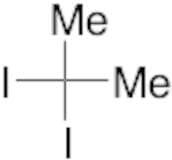
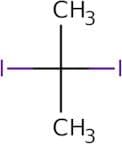
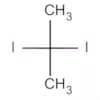
:Propane, 2,2-diiodo-
Description:
Propane, 2,2-diiodo- is an organic compound characterized by the presence of two iodine atoms attached to the second carbon of a propane backbone. Its molecular formula is C3H6I2, indicating that it contains three carbon atoms, six hydrogen atoms, and two iodine atoms. This compound is a member of the haloalkane family, which are known for their reactivity due to the presence of halogen atoms. The iodine substituents significantly influence the physical and chemical properties of the molecule, including its boiling point, solubility, and reactivity. Generally, compounds like 2,2-diiodopropane exhibit higher densities and boiling points compared to their non-iodinated counterparts due to the larger atomic mass and polarizability of iodine. Additionally, the presence of iodine can enhance the compound's reactivity in nucleophilic substitution reactions. Safety considerations are important when handling this compound, as iodine-containing compounds can be hazardous. Proper storage and handling protocols should be followed to mitigate any risks associated with exposure.
Formula:C3H6I2
Sort by
Purity (%)
0
100
|
0
|
50
|
90
|
95
|
100
Found 2 products.
2,2-Diiodopropane
CAS:Controlled ProductApplications 2,2-Diiodopropane is used in studying the Raman effect (isomerism rotation) and is used as a reagent in some synthetic preparations.
Not a dangerous good if item is equal to or less than 1g/ml and there is less than 100g/ml in the package
References Kahovec, L., et al: Z. Physik. Chem., B47, 48 (1940); Charette, A., et al: Synlett, 1, 176 (2002)Formula:C3H6I2Color and Shape:NeatMolecular weight:295.892,2-Diiodopropane
CAS:2,2-Diiodopropane is a chemical compound that is prepared in the laboratory by the reaction of an alcohol with iodine and deuterium. The reactant can be either an alcohol or a deuterated alcohol. The product has been studied using synchrotron radiation and absorption spectroscopy to determine its kinetics. When the reactant is an alcohol, the product has two different isotopes: one with mass number 2 and one with mass number 3. When the reactant is a deuterated alcohol, the product has two different isotopes: one with mass number 2 and one with mass number 3. The kinetic isotope effect refers to the change in rate of reaction due to substitution of atoms by their heavier isotopes (i.e., hydrogen). This effect can be observed when studying reactions involving water molecules as reactants or products.Formula:C3H6I2Purity:Min. 95%Molecular weight:295.89 g/mol