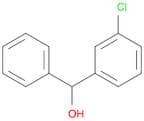
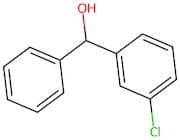
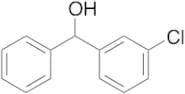
CAS 63012-03-3
:(3-chlorophenyl)(phenyl)methanol
Description:
(3-Chlorophenyl)(phenyl)methanol, identified by its CAS number 63012-03-3, is an organic compound characterized by the presence of a chlorophenyl group and a phenyl group attached to a central methanol moiety. This compound typically exhibits a white to off-white crystalline solid form. It is soluble in organic solvents such as ethanol and dichloromethane, but its solubility in water is limited due to its hydrophobic aromatic rings. The presence of the chlorine atom on the aromatic ring can influence its reactivity and polarity, making it a potential candidate for various chemical reactions, including nucleophilic substitutions and electrophilic aromatic substitutions. Additionally, the compound may exhibit biological activity, which can be explored in pharmaceutical applications. Its structural features suggest potential uses in organic synthesis and as an intermediate in the production of more complex molecules. Safety data should be consulted for handling and storage, as with any chemical substance, to ensure proper precautions are taken.
Formula:C13H11ClO
InChI:InChI=1/C13H11ClO/c14-12-8-4-7-11(9-12)13(15)10-5-2-1-3-6-10/h1-9,13,15H
SMILES:c1ccc(cc1)C(c1cccc(c1)Cl)O
Synonyms:- (3-Chlorophenyl)phenylmethanol
- Benzenemethanol, 3-chloro-alpha-phenyl-
- 3-Chlorobenzhydrol
Sort by
Purity (%)
0
100
|
0
|
50
|
90
|
95
|
100
Found 6 products.
(3-Chlorophenyl)(phenyl)methanol
CAS:(3-Chlorophenyl)(phenyl)methanolPurity:95%Molecular weight:218.68g/mol(3-Chlorophenyl)(phenyl)methanol
CAS:Controlled ProductApplications (3-chlorophenyl)(phenyl)methanol (cas# 63012-03-3) is a useful research chemical.
Formula:C13H11OClColor and Shape:NeatMolecular weight:218.67(3-Chlorophenyl)(phenyl)methanol
CAS:(3-Chlorophenyl)(phenyl)methanol is a chiral, optically active aldehyde that is used as a reagent in the synthesis of cellulose triacetate. The optical isomers of this compound are separated by densitometric analysis and the yields are determined by measuring the amount of solutes that elute from plates. The functional groups on this compound have been shown to react with dinitrophenyl and form an intermediate that can be identified as an alcohol.
Formula:C13H11ClOPurity:Min. 95%Molecular weight:218.68 g/mol