CAS 63037-63-8
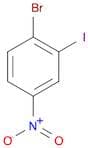
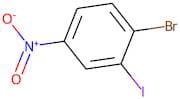
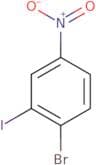
:1-bromo-2-iodo-4-nitrobenzene
Description:
1-Bromo-2-iodo-4-nitrobenzene is an aromatic halogenated compound characterized by the presence of both bromine and iodine substituents on a benzene ring, along with a nitro group. Its molecular formula is C6H3BrI(NO2), indicating a complex structure that includes halogens and a nitro functional group, which can influence its reactivity and physical properties. This compound typically appears as a solid at room temperature and is likely to be insoluble in water but soluble in organic solvents. The presence of the nitro group contributes to its electron-withdrawing properties, making the aromatic ring more reactive towards nucleophilic substitution reactions. Additionally, the combination of bromine and iodine substituents can lead to interesting reactivity patterns, including potential applications in organic synthesis and materials science. Safety precautions should be taken when handling this compound, as it may pose health risks due to its halogenated nature and potential toxicity.
Formula:C6H3BrINO2
InChI:InChI=1/C6H3BrINO2/c7-5-2-1-4(9(10)11)3-6(5)8/h1-3H
SMILES:c1cc(c(cc1N(=O)=O)I)Br
Sort by
Purity (%)
0
100
|
0
|
50
|
90
|
95
|
100
Found 4 products.
1-Bromo-2-iodo-4-nitrobenzene
CAS:Formula:C6H3BrINO2Purity:98%Color and Shape:SolidMolecular weight:327.90204-Bromo-3-iodonitrobenzene
CAS:4-Bromo-3-iodonitrobenzeneFormula:C6H3BrINO2Purity:≥95%Color and Shape: very dark red to very dark brown crystalline solidMolecular weight:327.90g/mol4-Bromo-3-iodonitrobenzene
CAS:Formula:C6H3BrINO2Purity:98%Color and Shape:SolidMolecular weight:327.9034-Bromo-3-iodonitrobenzene
CAS:4-Bromo-3-iodonitrobenzene is a pyrrole derivative that yields 4-bromo-3-iodobenzene upon treatment with palladium. It is a precursor to other products, such as 3-iodo-4-(pyrrolidinomethyl)benzoic acid and 4-(pyrrolidinomethyl)benzoic acid. This compound can be used in the synthesis of biomolecules, such as nucleosides, nucleotides, amino acids, peptides, and proteins. The synthesis of this compound involves deuterium exchange between the bromine and the hydrogen on the nitrogen atom. For example, if 4-bromo-3-iodonitrobenzene reacts with sodium methoxide in methanol it will produce 4-(methylamino)-3-(iodomethyl)aniline hydrochloride. The reaction yield of this
Formula:C6H3BrINO2Purity:Min. 95%Molecular weight:327.9 g/mol