CAS 631-22-1
:1,3-Diethyl 2,2-dibromopropanedioate
Description:
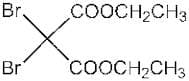
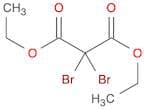
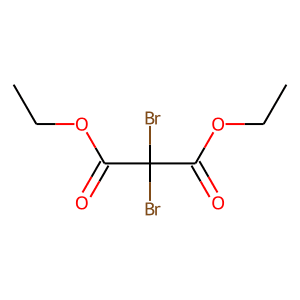
1,3-Diethyl 2,2-dibromopropanedioate, with the CAS number 631-22-1, is an organic compound belonging to the class of diesters. It features a propanedioate backbone with two ethyl groups attached to the first carbon and two bromine atoms on the second carbon. This compound is typically characterized by its relatively low solubility in water, owing to its hydrophobic ethyl groups, but it is soluble in organic solvents such as ethanol and dichloromethane. The presence of bromine atoms contributes to its reactivity, making it useful in various synthetic applications, including as an intermediate in organic synthesis. Additionally, the diester functional groups impart certain chemical properties, such as the ability to undergo hydrolysis and transesterification reactions. The compound may also exhibit moderate toxicity, necessitating careful handling in laboratory settings. Overall, 1,3-Diethyl 2,2-dibromopropanedioate is a versatile chemical with applications in organic chemistry and materials science.
Formula:C7H10Br2O4
InChI:InChI=1S/C7H10Br2O4/c1-3-12-5(10)7(8,9)6(11)13-4-2/h3-4H2,1-2H3
InChI key:InChIKey=PFZYFZRUPFUEOB-UHFFFAOYSA-N
SMILES:C(C(OCC)=O)(C(OCC)=O)(Br)Br
Synonyms:- 1,3-Diethyl 2,2-dibromopropanedioate
- 2,2-Dibromomalonic acid diethyl ester
- Bis(ethoxycarbonyl)dibromomethane
- Dibromomalonic acid diethyl ester
- Diethyl 2,2-dibromopropanedioate
- Diethyl Dibromopropanedioate
- Ethyl dibromomalonate
- Malonic acid, dibromo-, diethyl ester
- NSC 6759
- Propanedioic acid, 2,2-dibromo-, 1,3-diethyl ester
- Propanedioic acid, dibromo-, diethyl ester
- See more synonyms
Sort by
Purity (%)
0
100
|
0
|
50
|
90
|
95
|
100
Found 5 products.
Diethyl dibromomalonate, 96%
CAS:This Thermo Scientific Chemicals brand product was originally part of the Alfa Aesar product portfolio. Some documentation and label information may refer to the legacy brand. The original Alfa Aesar product / item code or SKU reference has not changed as a part of the brand transition to Thermo SciFormula:C7H10Br2O4Purity:96%Color and Shape:Clear colorless to pale yellow, LiquidMolecular weight:317.96Diethyl 2,2-dibromomalonate
CAS:Diethyl 2,2-dibromomalonateFormula:C7H10Br2O4Purity:≥95%Color and Shape: clear. light yellow liquidMolecular weight:317.96g/mol1,3-diethyl 2,2-dibromopropanedioate
CAS:1,3-diethyl 2,2-dibromopropanedioate is a hydrogen bond donor that is used as an anti-inflammatory compound. It has been shown to inhibit the proliferation of growth factors in vitro and to have antioxidant activity. The synthesis of 1,3-diethyl 2,2-dibromopropanedioate is initiated by the condensation of malonic acid with dimethyl fumarate in the presence of a solid catalyst. This reaction produces a mixture of 1,3-diethyl 2,2-dibromopropanedioate and its corresponding diethyl ester. The diethyl ester can be converted into 1,3-diethyl 2,2-dibromopropanedioate by heating it under vacuum for 24 hours at 250°C. This process also removes any water or other impurities that may be present. The asymmetric synthesis of 1,3-dFormula:C7H10Br2O4Purity:Min. 95%Molecular weight:317.96 g/mol