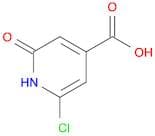
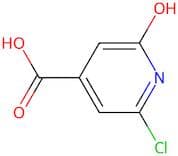
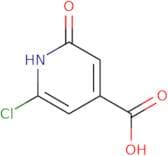
CAS 6313-51-5
:6-chloro-2-oxo-1,2-dihydropyridine-4-carboxylic acid
Description:
6-Chloro-2-oxo-1,2-dihydropyridine-4-carboxylic acid is a heterocyclic compound characterized by its pyridine ring structure, which features a chlorine atom and a carboxylic acid functional group. This compound typically exhibits a pale yellow to light brown appearance and is soluble in polar solvents due to the presence of the carboxylic acid group. The presence of the chloro substituent can influence its reactivity, making it a potential candidate for various chemical reactions, including nucleophilic substitutions. The diketone functionality contributes to its ability to participate in condensation reactions, while the carboxylic acid group can engage in acid-base chemistry. This compound may also exhibit biological activity, making it of interest in pharmaceutical research. Its molecular structure allows for potential interactions with biological targets, which could lead to applications in drug development. As with many chemical substances, safety precautions should be observed when handling this compound, as it may pose health risks if ingested or inhaled.
Formula:C6H4ClNO3
InChI:InChI=1/C6H4ClNO3/c7-4-1-3(6(10)11)2-5(9)8-4/h1-2H,(H,8,9)(H,10,11)
SMILES:c1c(cc(nc1Cl)O)C(=O)O
Synonyms:- 4-Pyridinecarboxylic Acid, 2-Chloro-6-Hydroxy-
- 2-Chloro-6-Hydroxyisonicotinic Acid
Sort by
Purity (%)
0
100
|
0
|
50
|
90
|
95
|
100
Found 4 products.
2-Chloro-6-Hydroxyisonicotinic Acid
CAS:Formula:C6H4ClNO3Purity:97%Color and Shape:SolidMolecular weight:173.55396-Chloro-2-oxo-1,2-dihydropyridine-4-carboxylic acid
CAS:6-Chloro-2-oxo-1,2-dihydropyridine-4-carboxylic acidPurity:97%Molecular weight:173.56g/mol2-CHLORO-6-HYDROXYISONICOTINIC ACID
CAS:Formula:C6H4ClNO3Purity:95%Color and Shape:SolidMolecular weight:173.556-chloro-2-oxo-1,2-dihydropyridine-4-carboxylic acid
CAS:6-Chloro-2-oxo-1,2-dihydropyridine-4-carboxylic acid (6CODPC) is a carboxylic acid that is an active ingredient in some fungicides. It has been shown to inhibit the growth of certain plant pathogens such as viruses and bacteria. 6CODPC binds to the enzyme ribonucleotide reductase, which is involved in DNA synthesis and replication, leading to the inhibition of RNA synthesis and protein synthesis. This leads to cell death by apoptosis. 6CODPC also inhibits the production of proteins in plants that are necessary for photosynthesis.
Formula:C6H4ClNO3Purity:Min. 95%Molecular weight:173.6 g/molRef: 3D-GAA31351
Discontinued product