


CAS 63149-33-7
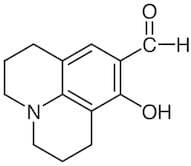
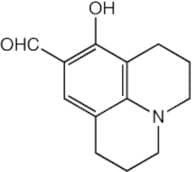
:8-Hydroxyjulolidine-9-carboxaldehyde
- 1H,5H-Benzo(ij)quinolizine-9-carboxaldehyde, 2,3,6,7-tetrahydro-8-hydroxy-
- 8-Hydroxyjulolidine-9-carboxaldehyde
- 9-Formyl-8-hydroxy-2,3,6,7-tetrahydro-1H,5H-benzo[ij]quinolizine
- 9-Formyl-8-hydroxyjulolidine
- 9-Formyl-8-julolidinol
- 2,3,6,7-Tetrahydro-8-hydroxy-1H,5H-benzo[ij]quinolizine-9-carboxaldehyde
- 2,3,6,7-Tetrahydro-8-hydroxy-1H,5H-benzo(ij)quinolizine-9-carboxaldehyde
8-Hydroxyjulolidine-9-carboxaldehyde
CAS:Formula:C13H15NO2Purity:>96.0%(GC)(T)Color and Shape:White to Amber to Dark green powder to crystalMolecular weight:217.279-Formyl-8-hydroxyjulolidine, 97%
CAS:This Thermo Scientific Chemicals brand product was originally part of the Alfa Aesar product portfolio. Some documentation and label information may refer to the legacy brand. The original Alfa Aesar product / item code or SKU reference has not changed as a part of the brand transition to Thermo SciFormula:C13H15NO2Purity:97%Color and Shape:Pale green, PowderMolecular weight:217.278-Hydroxy-1,2,3,5,6,7-hexahydropyrido[3,2,1-ij]quinoline-9-carbaldehyde
CAS:Formula:C13H15NO2Purity:98%Color and Shape:SolidMolecular weight:217.26378-Hydroxy-2,3,6,7-tetrahydro-1H,5H-pyrido[3,2,1-ij]quinoline-9-carbaldehyde
CAS:8-Hydroxy-2,3,6,7-tetrahydro-1H,5H-pyrido[3,2,1-ij]quinoline-9-carbaldehydePurity:97%Molecular weight:217.27g/mol2,3,6,7-Tetrahydro-8-hydroxy-1H,5H-benzo[ij]quinolizine-9-carboxaldehyde
CAS:Formula:C13H15NO2Molecular weight:217.278-Hydroxy-1,2,3,5,6,7-hexahydropyrido[3,2,1-ij]quinoline-9-carbaldehyde
CAS:Purity:95.0%Color and Shape:SolidMolecular weight:217.268005371093758-Hydroxy-2,3,6,7-tetrahydro-1H,5H-pyrido[3,2,1-ij]quinoline-9-carbaldehyde
CAS:8-Hydroxy-2,3,6,7-tetrahydro-1H,5H-pyrido[3,2,1-ij]quinoline-9-carbaldehyde (8OHPQCA) is a chemical species that exhibits biological properties. It has been shown to be a platinum-based chemotherapy drug and it is the first experimental platinum anticancer agent with low toxicity. 8OHPQCA inhibits the growth of mammalian cells by binding to DNA and inhibiting synthesis of proteins. The mechanism of action involves the formation of hydrogen bonds between 8OHPQCA and protonated guanine in DNA. This leads to intramolecular hydrogen bonding and a decrease in the optical properties of 8OHPQCA. Hydrolysis by enzymes such as mitochondrial matrix lead to release of free radicals that are cytotoxic. 8OHPQCA can also bind to magnetic resonance spectroscopy probes for low detection and optical sensors for
Formula:C13H15NO2Purity:Min. 95%Color and Shape:PowderMolecular weight:217.26 g/mol


![8-Hydroxy-1,2,3,5,6,7-hexahydropyrido[3,2,1-ij]quinoline-9-carbaldehyde](/_next/image/?url=https%3A%2Fstatic.cymitquimica.com%2Fproducts%2FIN%2Fthumb%2FDA003NIE.jpg&w=3840&q=75)

![8-Hydroxy-2,3,6,7-tetrahydro-1H,5H-pyrido[3,2,1-ij]quinoline-9-carbaldehyde](/_next/image/?url=https%3A%2Fstatic.cymitquimica.com%2Fproducts%2F54%2Fthumb%2FOR74754.jpg&w=3840&q=75)

![2,3,6,7-Tetrahydro-8-hydroxy-1H,5H-benzo[ij]quinolizine-9-carboxaldehyde](/_next/image/?url=https%3A%2Fstatic.cymitquimica.com%2Fproducts%2F7W%2Fthumb%2FGT1501.jpg&w=3840&q=75)

![8-Hydroxy-1,2,3,5,6,7-hexahydropyrido[3,2,1-ij]quinoline-9-carbaldehyde](/_next/image/?url=https%3A%2Fstatic.cymitquimica.com%2Fproducts%2F10%2Fthumb%2FF240265.jpg&w=3840&q=75)

![8-Hydroxy-2,3,6,7-tetrahydro-1H,5H-pyrido[3,2,1-ij]quinoline-9-carbaldehyde](/_next/image/?url=https%3A%2Fstatic.cymitquimica.com%2Fproducts%2F3D%2Fthumb%2FFH58873.jpg&w=3840&q=75)
