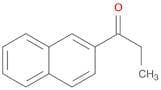
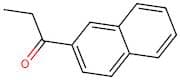
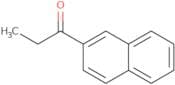
CAS 6315-96-4
:1-(2-Naphthalenyl)-1-propanone
Description:
1-(2-Naphthalenyl)-1-propanone, also known as 2-Naphthylacetone, is an organic compound characterized by its structure, which features a naphthalene ring attached to a propanone group. This compound typically appears as a pale yellow to light brown liquid or solid, depending on its purity and temperature. It has a distinct aromatic odor, indicative of its naphthalene component. The molecular formula of 1-(2-Naphthalenyl)-1-propanone reflects its composition, which includes carbon, hydrogen, and oxygen atoms. It is known for its applications in organic synthesis, particularly in the production of various pharmaceuticals and fragrances. The compound exhibits moderate solubility in organic solvents, while being less soluble in water due to its hydrophobic nature. Additionally, it may undergo typical organic reactions such as oxidation and reduction, making it a versatile intermediate in chemical synthesis. Safety data indicates that it should be handled with care, as it may pose health risks upon exposure.
Formula:C13H12O
InChI:InChI=1S/C13H12O/c1-2-13(14)12-8-7-10-5-3-4-6-11(10)9-12/h3-9H,2H2,1H3
InChI key:InChIKey=QLYPHTMKMPIJNG-UHFFFAOYSA-N
SMILES:C(CC)(=O)C1=CC2=C(C=C1)C=CC=C2
Synonyms:- 1-(2-Naphthalenyl)-1-propanone
- 1-(2-Naphthyl)-1-propanone
- 1-(Naphthalen-2-Yl)Propan-1-One
- 1-Propanone, 1-(2-naphthalenyl)-
- 2-Propionaphthone
- 2-Propionylnaphthalene
- NSC 21044
- β-Propionaphthone
- 1-(2-Naphthyl)propan-1-one
Sort by
Purity (%)
0
100
|
0
|
50
|
90
|
95
|
100
Found 4 products.
1-(2-naphthyl)propan-1-one
CAS:Formula:C13H12OPurity:97%Color and Shape:SolidMolecular weight:184.23381-(Naphthalen-2-yl)propan-1-one
CAS:1-(Naphthalen-2-yl)propan-1-onePurity:97%Molecular weight:184.24g/mol1-naphthalen-2-ylpropan-1-one
CAS:1-naphthalen-2-ylpropan-1-one is a linear acyl compound that is used in the synthesis of other compounds. It reacts with propanoic acid to form 1,2-diphenylethane. The reaction also produces an acylation product and propanoic acid as a byproduct. This reaction is an example of an acylation reaction, which is the process of adding an organic acid group to a hydrocarbon molecule. The result of this reaction is shown in the diagram below.Formula:C13H12OPurity:Min. 95%Molecular weight:184.23 g/mol