CAS 6322-60-7
:4-(4-oxo-2-thioxo-1,3-thiazolidin-3-yl)benzoate
Description:
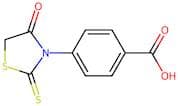
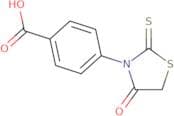
4-(4-oxo-2-thioxo-1,3-thiazolidin-3-yl)benzoate, with the CAS number 6322-60-7, is a chemical compound that belongs to the class of thiazolidinones, which are characterized by a five-membered ring containing sulfur and nitrogen atoms. This compound features a thiazolidinone moiety linked to a benzoate group, indicating the presence of a benzene ring substituted with a carboxylate functional group. The thiazolidinone structure contributes to its potential biological activity, as compounds in this class are often investigated for their pharmacological properties, including antimicrobial and anti-inflammatory effects. The presence of the thioxo group (a sulfur atom double-bonded to a carbon atom) enhances the reactivity of the molecule, potentially influencing its interactions in biological systems. Additionally, the compound may exhibit solubility characteristics influenced by the benzoate group, which can affect its bioavailability and application in medicinal chemistry. Overall, 4-(4-oxo-2-thioxo-1,3-thiazolidin-3-yl)benzoate is of interest for its structural features and potential therapeutic applications.
Formula:C10H6NO3S2
InChI:InChI=1/C10H7NO3S2/c12-8-5-16-10(15)11(8)7-3-1-6(2-4-7)9(13)14/h1-4H,5H2,(H,13,14)/p-1
SMILES:c1cc(ccc1C(=O)O)N1C(=O)CSC1=S
Synonyms:- 4-(4-Oxo-2-thioxo-thiazolidin-3-yl)-benzoic acid
- Benzoic Acid, 4-(4-Oxo-2-Thioxo-3-Thiazolidinyl)-
Sort by
Purity (%)
0
100
|
0
|
50
|
90
|
95
|
100
Found 3 products.
4-(4-Oxo-2-thioxothiazolidin-3-yl)benzoic acid
CAS:4-(4-Oxo-2-thioxothiazolidin-3-yl)benzoic acidPurity:95%Molecular weight:253.3g/mol4-(4-Oxo-2-thioxo-thiazolidin-3-yl)-benzoic acid
CAS:Formula:C10H7NO3S2Purity:95.0%Molecular weight:253.294-(4-Oxo-2-sulfanylidene-1,3-thiazolidin-3-yl)benzoic acid
CAS:4-(4-Oxo-2-sulfanylidene-1,3-thiazolidin-3-yl)benzoic acid (L-OTSA) is a potent inhibitor of the uptake of potassium ions into cells. It binds to the extracellular surface of the cell membrane and prevents potassium from entering the cell. This results in hyperpolarization of the membrane potential and an increase in spontaneous activity. L-OTSA also induces electrophysiological effects such as increased spontaneous activity, decreased action potential duration, and increased threshold for excitation. L-OTSA has been found to inhibit cellular uptake of potassium ions.Formula:C10H7NO3S2Purity:Min. 95%Molecular weight:253.3 g/mol