CAS 634-62-8
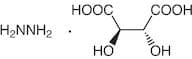
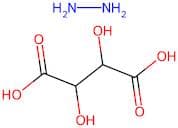
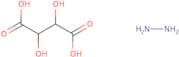
:Hydrazine, (2R,3R)-2,3-dihydroxybutanedioate (1:1)
Description:
Hydrazine, (2R,3R)-2,3-dihydroxybutanedioate (1:1), commonly referred to by its CAS number 634-62-8, is a chemical compound that features a hydrazine moiety combined with a dihydroxybutanedioate structure. This compound is characterized by its ability to act as a reducing agent and is often utilized in various chemical syntheses and applications, including as a precursor in the production of pharmaceuticals and agrochemicals. The presence of hydroxyl groups in its structure contributes to its reactivity and solubility in polar solvents. Additionally, the stereochemistry indicated by the (2R,3R) configuration suggests specific spatial arrangements of its atoms, which can influence its biological activity and interactions. Hydrazine derivatives are known for their potential toxicity and should be handled with care, as they can pose health risks upon exposure. Overall, this compound exemplifies the diverse functionalities of hydrazine derivatives in organic chemistry and their relevance in industrial applications.
Formula:C4H6O6·H4N2
InChI:InChI=1S/C4H6O6.H4N2/c5-1(3(7)8)2(6)4(9)10;1-2/h1-2,5-6H,(H,7,8)(H,9,10);1-2H2/t1-,2-;/m1./s1
InChI key:InChIKey=GHPDWAAGDJPBLL-ZVGUSBNCSA-N
SMILES:NN.[C@@H]([C@H](C(O)=O)O)(C(O)=O)O
Synonyms:- Hydrazine 2,3-Dihydroxybutanedioate (1:1)
- Hydrazine L-(+)-tartrate
- Hydrazine monotartrate
- Hydrazine tartrate
- Hydrazine, (2R,3R)-2,3-dihydroxybutanedioate (1:1)
- Hydrazine, [R-(R*,R*)]-2,3-dihydroxybutanedioate (1:1)
- Hydrazonium <span class="text-smallcaps">L</span>-tartrate
- Tartaric acid, compd. with hydrazine
- Tartaric acid, compd. with hydrazine (1:1), (+)-
Sort by
Purity (%)
0
100
|
0
|
50
|
90
|
95
|
100
Found 4 products.
Hydrazine L-(+)-Tartrate
CAS:Formula:H4N2·C4H6O6Purity:>98.0%(T)Color and Shape:White to Almost white powder to crystalMolecular weight:182.13Hydrazine L-(+)-Tartrate
CAS:Controlled ProductHydrazine L-(+)-Tartrate is a fluorescent probe that is used to measure nitrates in wastewater. It reacts with nitrates in the presence of water vapor, producing a chemiluminescent signal. The fluorescence intensity is proportional to the concentration of nitrates. This reaction can be measured using a chemiluminescence method or by x-ray diffraction data. Hydrazine L-(+)-Tartrate has also been used as a reagent for the determination of phosphorus pentoxide and sulfate in analytical methods. Hydrolysis of hydrazine produces nitrous acid, which can react with hydrogen sulfide to produce sulfur dioxide and water vapor. Hydrolysis of hydrazine may occur when it reacts with hyperproliferative cells.Formula:H4N2·C4H6O6Purity:Min. 95%Molecular weight:182.13 g/mol