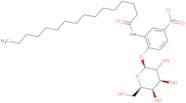
![N-[2-(β-D-Galactopyranosyloxy)-5-nitrophenyl]hexadecanamide](/_next/image/?url=https%3A%2Fstatic.cymitquimica.com%2Fcas-image%2Fthumb-webp%2F167616-n-2-b-d-galactopyranosyloxy-5-nitrophenyl-palmitamide.webp&w=3840&q=75)
CAS 63424-42-0
:N-[2-(β-D-Galactopyranosyloxy)-5-nitrophenyl]hexadecanamide
- 2-Hexadecanoylamino-4-nitrophenyl β-<span class="text-smallcaps">D</span>-galactopyranoside
- 2-Hexadecanoylamino-4-nitrophenyl-beta-D-galactopyranoside
- Hexadecanamide, N-(2-(beta-D-galactopyranosyloxy)-5-nitrophenyl)-
- Hexadecanamide, N-[2-(β-<span class="text-smallcaps">D</span>-galactopyranosyloxy)-5-nitrophenyl]-
- N-(2-(beta-D-Galactopyranosyloxy)-5-nitrophenyl)palmitamide
- N-[2-(beta-D-galactopyranosyloxy)-5-nitrophenyl]hexadecanamide
- N-[2-(β-<span class="text-smallcaps">D</span>-Galactopyranosyloxy)-5-nitrophenyl]hexadecanamide
- 2-Hexadecanoylamino-4-nitrophenyl β-D-galactopyranoside
- N-[2-(β-D-Galactopyranosyloxy)-5-nitrophenyl]hexadecanamide
- Hexadecanamide, N-[2-(β-D-galactopyranosyloxy)-5-nitrophenyl]-
2’-(N-Hexadecanoylamino)-4’-nitrophenyl-β-D-galactopyranoside
CAS:2’-(N-Hexadecanoylamino)-4’-nitrophenyl-b-D-galactopyranoside is a synthetic substrate that is used to diagnose and monitor brain diseases. It can be used in the diagnosis of Alzheimer's disease by measuring the amount of amniotic fluid that leaks into the brain. The rate of hydrolysis of this substrate has been shown to be higher in patients with Alzheimer's disease than in healthy controls. This synthetic substrate is also useful for monitoring the activity of taurocholate galactohydrolase, which is an enzyme that breaks down bile salts and plays a role in cholesterol metabolism. The rate of hydrolysis has been found to be increased in patients with Parkinson's disease, but not in those with Alzheimer's disease or healthy controls. 2’-(N-Hexadecanoylamino)-4’-nitrophenyl-b-D-galactop
Formula:C28H46N2O9Purity:Min. 95%Color and Shape:PowderMolecular weight:554.67 g/mol2-Hexadecanoylamino-4-nitrophenyl β-D-Galactopyranoside
CAS:Controlled ProductFormula:C28H46N2O9Color and Shape:NeatMolecular weight:554.673