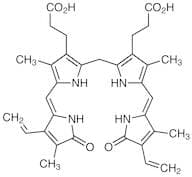
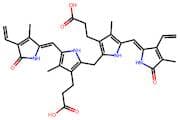
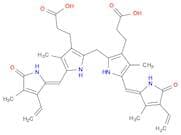
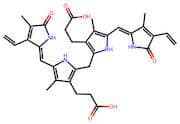
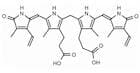
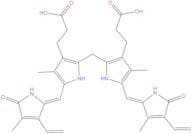
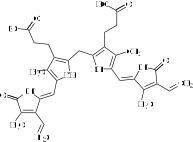
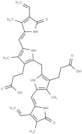
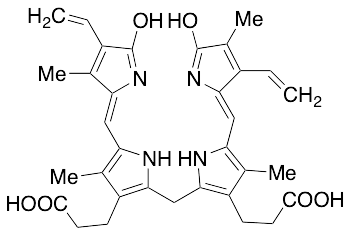
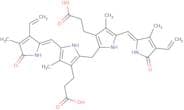
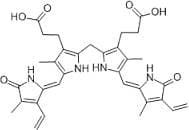
CAS 635-65-4
:Bilirubin
- (4Z,15Z)-Bilirubin IXα
- (Z,Z)-Bilirubin
- (Z,Z)-Bilirubin IXα
- 2,17-Diethenyl-1,10,19,22,23,24-hexahydro-3,7,13,18-tetramethyl-1,19-dioxo-21H-biline-8,12-dipropanoic Acid
- 21H-Biline-8,12-dipropanoic acid, 2,17-diethenyl-1,10,19,22,23,24-hexahydro-3,7,13,18-tetramethyl-1,19-dioxo-
- 3-[2-[[3-(2-carboxyethyl)-4-methyl-5-[(Z)-(4-methyl-5-oxo-3-vinyl-pyrrol-2-ylidene)methyl]-1H-pyrrol-2-yl]methyl]-4-methyl-5-[(Z)-(3-methyl-5-oxo-4-vinyl-pyrrol-2-ylidene)methyl]-1H-pyrrol-3-yl]propanoic acid
- 3-[2-[[3-(2-carboxyethyl)-4-methyl-5-[(Z)-(4-methyl-5-oxo-3-vinyl-pyrrol-2-ylidene)methyl]-1H-pyrrol-2-yl]methyl]-4-methyl-5-[(Z)-(3-methyl-5-oxo-4-vinyl-pyrrol-2-ylidene)methyl]-2H-pyrrol-3-yl]propanoic acid
- 3-[4-methyl-2-[[4-methyl-5-[(Z)-(4-methyl-5-oxo-3-vinyl-pyrrol-2-ylidene)methyl]-3-(3-oxido-3-oxo-propyl)-1H-pyrrol-2-yl]methyl]-5-[(Z)-(3-methyl-5-oxo-4-vinyl-pyrrol-2-ylidene)methyl]-1H-pyrrol-3-yl]propanoate
- Biline-8,12-dipropionic acid, 1,10,19,22,23,24-hexahydro-2,7,13,17-tetramethyl-1,19-dioxo-3,18-divinyl-
- Bilirubin IXα
- Bilirubin Powder
- Bilirubina
- Bilirubine
- Biliyubin
- Cholerythrin
- Hematoidin
- Nsc 26685
- See more synonyms
Bilirubin
CAS:Formula:C33H36N4O6Purity:>80.0%(HPLC)Color and Shape:Orange to Brown powder to crystalMolecular weight:584.67Bilirubin
CAS:BilirubinFormula:C33H36N4O6Purity:97% (nmr) (Typical Value in Batch COA)Color and Shape:Red-brown Solid-PowderMolecular weight:584.6621421H-Biline-8,12-dipropanoic acid,2,17-diethenyl-1,10,19,22,23,24-hexahydro-3,7,13,18-tetramethyl-1,19-dioxo-
CAS:Formula:C33H36N4O6Purity:97%Color and Shape:SolidMolecular weight:584.6621Bilirubin
CAS:Formula:C33H36N4O6Purity:≥ 95%Color and Shape:Orange to brown powderMolecular weight:584.68Bilirubin
CAS:Bilirubin (Principal bile pigment) is a metabolite of hemoglobin in the blood. Bilirubin has antimutagenic and antioxidant effects. Cost-effective and quality-assured.Formula:C33H36N4O6Purity:99.1% - ≥98%Color and Shape:SolidMolecular weight:584.66Bilirubin (>90%)
CAS:Controlled ProductApplications Principal pigment of bile and constituent of many biliary calculi.
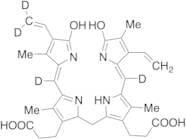
References Stenhagen, R., et al.: Biochem. J., 33, 1591 (1939), Gray, et al.: J. Chem. Soc., 2264, 2268 (1961),Formula:C33H36N4O6Purity:>90%Color and Shape:NeatMolecular weight:584.662Bilirubin-d4 (d3 Major) (Technical Grade)
CAS:Controlled ProductApplications Labelled Bilirubin (B385300), a principal pigment of bile and constituent of many biliary calculi.
References Stenhagen, R., et al.: Biochem. J., 33, 1591 (1939), Gray, et al.: J. Chem. Soc., 2264, 2268 (1961),Formula:C33H32D4N4O6Color and Shape:NeatMolecular weight:588.69Bilirubin
CAS:Bilirubin is a product of heme degradation, it is produced in the reticuloendothelial system by the reduction of biliverdin and transported to the liver as a complex with serum albumin. Insoluble yellow coloured bilirubin can be turned into water soluble iso-bilirubin by blue-light irradiation. This is the molecular basis of the standard treatment of neonatal hyperbilirubinemia (or Jaundice) by a fairly simple phototherapy. In a 2018 study by Lee et al., the solubility switch of bilirubin was used in a new type of bilirubin-based carriers for anti-cancer drugs.Formula:C33H36N4O6Purity:(Uv) Min. 99%Color and Shape:PowderMolecular weight:584.66 g/molBilirubin - unconjugated
CAS:Bilirubin is a is a product of heme degradation, produced by the reduction of biliverdin and transported to the liver as a complex with serum albumin. The two main types of bilirubin are conjugated and unconjugated, which differ in their solubility and how they are measured: Conjugated bilirubin (also known as direct bilirubin), this is the water-soluble form of bilirubin which has been conjugated with glucoronic acid and is excreted in the bile.Unconjugated bilirubin (also known as indirect bilirubin), this is the water-insoluble form of bilirubin that is bound to albumin in the blood on the way to the liver. It can't normally be measured directly in blood testing, so it's calculated by subtracting the conjugated bilirubin value from the total bilirubin value.This product, FB01720, contains the unconjugated (water insoluble) form of bilirubin only.
Formula:C33H36N4O6Molecular weight:584.66 g/molBilirubin extrapure AR, 99%
CAS:Formula:C33H36N4O6Purity:min. 99%Color and Shape:Yellowish orange, Crystalline powderMolecular weight:584.68Bilirubin
CAS:Bilirubin is a product of heme degradation, it is produced in the reticuloendothelial system by the reduction of biliverdin and transported to the liver as a complex with serum albumin. Insoluble yellow coloured bilirubin can be turned into water soluble iso-bilirubin by blue-light irradiation. This is the molecular basis of the standard treatment of neonatal hyperbilirubinemia (or Jaundice) by a fairly simple phototherapy. In a 2018 study by Lee et al., the solubility switch of bilirubin was used in a new type of bilirubin-based carriers for anti-cancer drugs.
Formula:C33H36N4O6Purity:(Uv) Min. 95.0%Molecular weight:584.68 g/mol