CAS 637-56-9
:Benzenamine, 4-ethoxy-, hydrochloride (1:1)
Description:
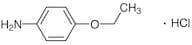
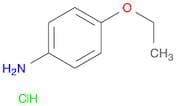
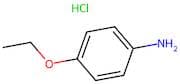
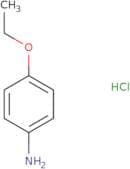
Benzenamine, 4-ethoxy-, hydrochloride (1:1), also known as 4-ethoxyaniline hydrochloride, is an organic compound characterized by its amine functional group attached to a benzene ring, with an ethoxy group (-OCH2CH3) at the para position. This compound appears as a white to off-white crystalline solid and is soluble in water due to the presence of the hydrochloride salt form, which enhances its solubility compared to the free base. It is commonly used in organic synthesis and as an intermediate in the production of dyes, pharmaceuticals, and agrochemicals. The presence of the ethoxy group contributes to its reactivity and influences its electronic properties, making it a valuable building block in various chemical reactions. Safety precautions should be observed when handling this compound, as it may pose health risks, including skin and respiratory irritation. Proper storage in a cool, dry place, away from incompatible substances, is essential to maintain its stability and efficacy.
Formula:C8H11NO·ClH
InChI:InChI=1S/C8H11NO.ClH/c1-2-10-8-5-3-7(9)4-6-8;/h3-6H,2,9H2,1H3;1H
InChI key:InChIKey=JVWYCUBGJVOEIZ-UHFFFAOYSA-N
SMILES:O(CC)C1=CC=C(N)C=C1.Cl
Synonyms:- 4-Ethoxyaniline Hydrochloride (1:1)
- 4-Ethoxyaniline hydrochloride
- 4-Ethoxyanilinium chloride
- Benzenamine, 4-ethoxy-, hydrochloride
- Benzenamine, 4-ethoxy-, hydrochloride (1:1)
- Phenetidine hydrochloride
- p-Phenetidine hydrochloride
Sort by
Purity (%)
0
100
|
0
|
50
|
90
|
95
|
100
Found 5 products.
p-Phenetidine Hydrochloride
CAS:Formula:C8H11NO·HClPurity:>98.0%(T)(HPLC)Color and Shape:White to Light yellow to Light red powder to crystalMolecular weight:173.644-Ethoxyaniline hydrochloride
CAS:Formula:C8H12ClNOPurity:98%Color and Shape:SolidMolecular weight:173.64004-Ethoxyaniline hydrochloride
CAS:4-Ethoxyaniline hydrochloridePurity:98%Molecular weight:173.64g/molp-Phenetidine Hydrochloride
CAS:p-Phenetidine hydrochloride is a pharmaceutical preparation that is used as an intermediate in the production of chlorate, which is used in the synthesis of other organochlorine compounds. It can be prepared by reacting p-phenetidine with a solution of hydrochloric acid and zirconium dichloride in a reaction vessel. The reaction products are then heat treated to produce a solid catalyst, which can be further reacted with organic acids to form metal ion complexes. These complexes are stable and can be separated from unreacted reactants by distillation or recrystallization. The kinetic method has been shown to be useful for determining the order of reaction between these complex ions. The benzalkonium chloride acts as a cocatalyst in this process, while the solid catalyst provides kinetic stability to the process.Formula:C8H11NO·HClPurity:Min. 95%Molecular weight:173.64 g/mol