CAS 637-57-0
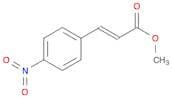
:(E)-Methyl 4-nitrocinnamate
Description:
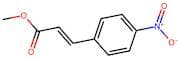
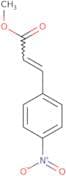
(E)-Methyl 4-nitrocinnamate, with the CAS number 637-57-0, is an organic compound characterized by its structure, which features a cinnamate backbone with a nitro group at the para position of the aromatic ring. This compound typically appears as a yellow to orange crystalline solid and is known for its aromatic properties. It is soluble in organic solvents such as ethanol and acetone but has limited solubility in water. The presence of the nitro group contributes to its reactivity and potential applications in organic synthesis, particularly in the development of pharmaceuticals and agrochemicals. Additionally, (E)-Methyl 4-nitrocinnamate can undergo various chemical reactions, including nucleophilic substitutions and reductions, making it a valuable intermediate in synthetic chemistry. Its stability under standard conditions allows for its use in various laboratory settings, although care should be taken due to the potential toxicity associated with nitro compounds. Overall, this compound is significant in both academic research and industrial applications.
Formula:C10H9NO4
InChI:InChI=1S/C10H9NO4/c1-15-10(12)7-4-8-2-5-9(6-3-8)11(13)14/h2-7H,1H3/b7-4+
InChI key:InChIKey=NVXKMHUNXMXXDM-QPJJXVBHSA-N
SMILES:C(=C/C(OC)=O)\C1=CC=C(N(=O)=O)C=C1
Synonyms:- Cinnamic acid, p-nitro-, methyl ester, (E)-
- trans-Methyl p-nitrocinnamate
- 2-Propenoic acid, 3-(4-nitrophenyl)-, methyl ester, (2E)-
- (E)-Methyl p-nitrocinnamate
- 2-Propenoic acid, 3-(4-nitrophenyl)-, methyl ester, (E)-
Sort by
Purity (%)
0
100
|
0
|
50
|
90
|
95
|
100
Found 4 products.
Methyl trans-3-(4-nitrophenyl)prop-2-enoate
CAS:Formula:C10H9NO4Purity:95%Color and Shape:SolidMolecular weight:207.1828(E)-Methyl 3-(4-nitrophenyl)acrylate
CAS:(E)-Methyl 3-(4-nitrophenyl)acrylate
Purity:95%Molecular weight:207.18g/molMethyl (2E)-3-(4-nitrophenyl)prop-2-enoate
CAS:Methyl (2E)-3-(4-nitrophenyl)prop-2-enoate is an electrophilic arylating agent that is used for the synthesis of tosylates, cinnamates, and nitrates. It has been shown to be an efficient catalyst for the aromatic arylation of acrylic acid with electron-deficient alkenes. This reagent can also be used for the synthesis of nitrated alkenes and nitro alkenes by reaction with sodium nitrate in the presence of chlorine.Formula:C10H9NO4Purity:Min. 95%Molecular weight:207.18 g/mol