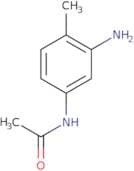
CAS 6375-16-2
:N-(3-Amino-4-methylphenyl)acetamide
Description:
N-(3-Amino-4-methylphenyl)acetamide, also known by its CAS number 6375-16-2, is an organic compound characterized by its amide functional group. It features an acetamide moiety attached to a phenyl ring that is substituted with an amino group and a methyl group. This compound typically appears as a solid at room temperature and is soluble in polar solvents due to the presence of the amine and amide functionalities, which can engage in hydrogen bonding. The presence of the amino group suggests potential basicity, while the methyl substitution can influence its steric and electronic properties. N-(3-Amino-4-methylphenyl)acetamide may exhibit biological activity, making it of interest in pharmaceutical research. Its structural characteristics can lead to interactions with various biological targets, potentially influencing its pharmacological profile. As with many organic compounds, handling should be done with care, considering safety data and potential hazards associated with its use.
Formula:C9H12N2O
InChI:InChI=1S/C9H12N2O/c1-6-3-4-8(5-9(6)10)11-7(2)12/h3-5H,10H2,1-2H3,(H,11,12)
InChI key:InChIKey=RBQWGHBZCHFUQU-UHFFFAOYSA-N
SMILES:N(C(C)=O)C1=CC(N)=C(C)C=C1
Synonyms:- 1-(2-Fluorophenyl)-3-{5-[(4-Nitrophenoxy)Methyl]-1,3,4-Thiadiazol-2-Yl}Urea
- 2-Amino-4-acetylaminotoluene
- 3'-Amino-4'-methylacetanilide
- 3′-Amino-p-acetotoluidide
- 4-Acetylamino-2-aminotoluene
- 4-Acetylamino-2-toluidine
- 5-Acetamido-2-methylaniline
- Acetamide, N-(3-amino-4-methylphenyl)-
- Acetanilide, 3'-amino-4'-methyl-
- Ba 8315
- Brn 2804114
- Ccris 2681
- N,N'-(2,2-dimethylpropane-1,3-diyl)bis(3-phenylprop-2-enamide)
- p-Acetotoluidide, 3′-amino-
- 2-13-00-00062 (Beilstein Handbook Reference)
- N-(3-Amino-4-methylphenyl)acetamide
- See more synonyms
Sort by
Purity (%)
0
100
|
0
|
50
|
90
|
95
|
100
Found 1 products.
N-(3-Amino-4-methylphenyl)acetamide
CAS:<p>Acetaminophen, also known as paracetamol, is a widely used drug for pain relief and fever reduction. It is metabolized by the liver, mainly through the cytochrome P450 pathway. The cytochrome P450 pathway produces reactive intermediates that can cause oxidative stress and DNA damage. Acetaminophen has been shown to be toxic to rat primary hepatocytes in vitro at concentrations of 40-160 μM after 24 hours. Acetaminophen has also been shown to be mutagenic and carcinogenic in rats at doses of 5000 mg/kg/day, which is equivalent to a human dose of 160 mg/kg/day or higher. These effects are due to acetaminophen’s metabolic activation by reactive oxygen species (ROS) and its ability to induce cytotoxicity and oxidative stress in cells.</p>Formula:C9H12N2OPurity:Min. 95%Molecular weight:164.2 g/mol