CAS 63763-79-1
:2-(bromomethyl)-6-chloropyridine
Description:
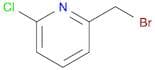
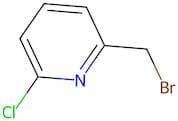
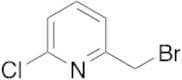
2-(Bromomethyl)-6-chloropyridine is an organic compound characterized by its pyridine ring, which is a six-membered aromatic heterocycle containing one nitrogen atom. This compound features a bromomethyl group (-CH2Br) and a chlorine atom (Cl) attached to the pyridine ring, specifically at the 2 and 6 positions, respectively. The presence of these halogen substituents significantly influences its reactivity and physical properties. Typically, compounds like this exhibit moderate to high polarity due to the electronegative halogens, which can also enhance their solubility in polar solvents. The bromomethyl group can serve as a reactive site for further chemical transformations, making it useful in synthetic organic chemistry. Additionally, the compound may exhibit biological activity, which can be explored in medicinal chemistry. Its applications may include use as an intermediate in the synthesis of pharmaceuticals or agrochemicals. Safety precautions should be taken when handling this compound, as halogenated organic compounds can pose health and environmental risks.
Formula:C6H5BrClN
InChI:InChI=1/C6H5BrClN/c7-4-5-2-1-3-6(8)9-5/h1-3H,4H2
SMILES:c1cc(CBr)nc(c1)Cl
Synonyms:- Pyridine, 2-(Bromomethyl)-6-Chloro-
Sort by
Purity (%)
0
100
|
0
|
50
|
90
|
95
|
100
Found 5 products.
2-(Bromomethyl)-6-chloropyridine
CAS:Formula:C6H5BrClNPurity:95%Color and Shape:SolidMolecular weight:206.46762-Chloro-6-(Bromomethyl)Pyridine
CAS:2-Chloro-6-(Bromomethyl)PyridinePurity:96%Molecular weight:206.47g/mol2-(Bromomethyl)-6-chloropyridine
CAS:Controlled ProductFormula:C6H5BrClNColor and Shape:NeatMolecular weight:206.4682-(bromomethyl)-6-chloropyridine
CAS:2-(bromomethyl)-6-chloropyridine is a ligand that binds to metal atoms. It forms a complex with the metal atom by coordinating with two or more bromine atoms and one or two hydrogens. 2-(Bromomethyl)-6-chloropyridine has been shown to interact with pyridine, x-ray diffraction studies, crystal x-ray diffraction, and ligands in crystal x-ray diffraction studies. The conformation of this compound can be deformed by substituting the methyl group on the chloro group for other moieties. These interactions have been shown using X-Ray diffraction studies and crystal x-ray diffraction studies.
Formula:C6H5BrClNPurity:Min. 95%Molecular weight:206.47 g/mol