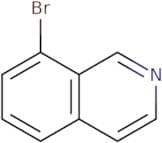
CAS 63927-22-0
:8-bromoisoquinoline
Description:
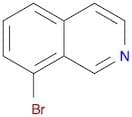
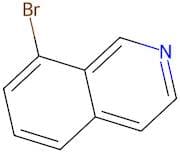
8-Bromoisoquinoline is an organic compound characterized by its isoquinoline structure, which consists of a fused benzene and pyridine ring. The presence of a bromine atom at the 8-position of the isoquinoline ring significantly influences its chemical properties and reactivity. This compound typically appears as a pale yellow to brown solid and is sparingly soluble in water but more soluble in organic solvents such as ethanol and dichloromethane. 8-Bromoisoquinoline is known for its potential applications in medicinal chemistry, particularly in the development of pharmaceuticals, due to its ability to interact with biological targets. It can participate in various chemical reactions, including nucleophilic substitutions and coupling reactions, making it a valuable intermediate in organic synthesis. Additionally, the bromine substituent can serve as a handle for further functionalization, enhancing its versatility in chemical transformations. As with many brominated compounds, it is essential to handle 8-bromoisoquinoline with care due to potential toxicity and environmental concerns associated with brominated organic compounds.
Formula:C12H13N
InChI:InChI=1/C12H13N/c1-9(2)12-11-6-4-3-5-10(11)7-8-13-12/h3-9H,1-2H3
SMILES:CC(C)c1c2ccccc2ccn1
Synonyms:- Isoquinoline, 8-bromo-
- 1-(1-Methylethyl)Isoquinoline
Sort by
Purity (%)
0
100
|
0
|
50
|
90
|
95
|
100
Found 6 products.
8-Bromoisoquinoline
CAS:8-BromoisoquinolineFormula:C9H6BrNPurity:95%Color and Shape:PowderMolecular weight:208.05g/mol8-Bromoisoquinoline
CAS:Formula:C9H6BrNPurity:>97.0%(GC)(T)Color and Shape:Light orange to Yellow to Green powder to crystalMolecular weight:208.068-Bromoisoquinoline
CAS:8-Bromoisoquinoline is a bifunctional alkylating agent that is used to synthesize esters and amides. It is commonly used for the synthesis of amino acids, peptides, and other biologically active molecules. 8-Bromoisoquinoline has been shown to have a synergistic effect with hydroxyalkyl carbamates, which may be due to its ability to form an ionic bond with the carboxylic acid in these compounds. This chemical can also react with nitro groups and serve as a chlorinating agent, as well as react with anions such as phosphate and acetate. 8-Bromoisoquinoline can be synthesized by reacting ethyl bromoacetate with tetrahydroisoquinolinium chloride in hydrochloric acid or isopropyl alcohol.
Formula:C9H6BrNPurity:Min. 95%Color and Shape:PowderMolecular weight:208.05 g/mol